
Civic Education In Spain. Legislative transformations in the last half-century
DOI:
https://doi.org/10.12795/CP.2020.i29.v2.07Keywords:
educational policy, education reform, educational legislation, curriculum, civic education, moral educationAbstract
It is obvious that schools can exert a great influence as appropriate areas to foster a fairer and more equitable society, with greater moral, civic and political commitment among citizens. Civic education contributes to this end and, therefore, it has been introduced -with different appellations- in the curriculums of most Western countries to facilitate citizens the assumption of their rights and responsibilities. This is considered as one way of transmitting the necessary knowledge, skills and attitudes for young people to become active citizens with the capacity to build the future for our democratic societies.
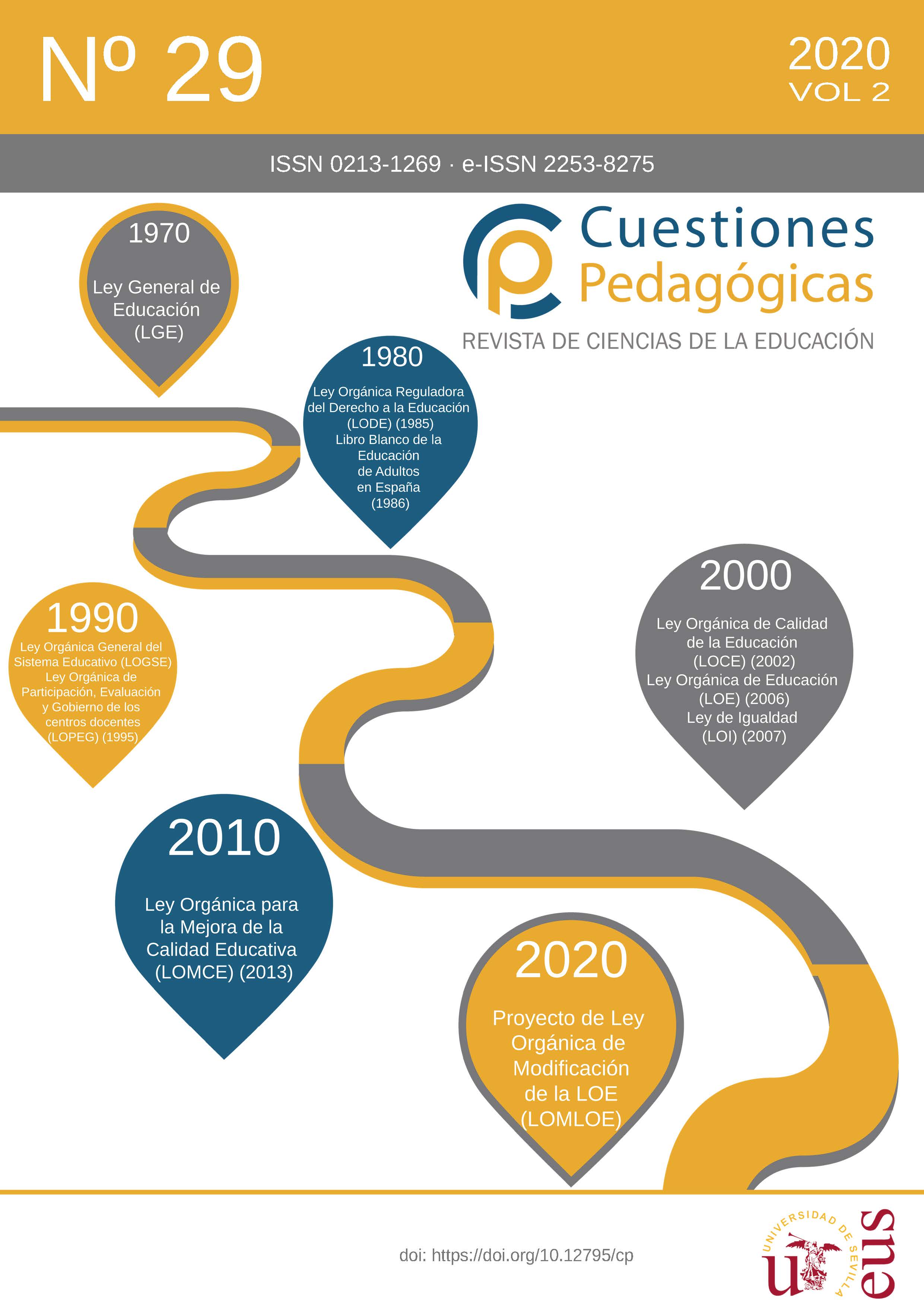
The education reforms performed in different countries highlight the need for citizenship education by advocating for their incorporation in the syllabus. The objective of this article is to point out the attention that civic education has received in Spain, specially from the implementation of the 1970 General Education Act. To do so, the successive reforms that have been introduced until today are analyzed.
We ask ourselves whether these curricular reforms succeed in improving the civic competence of our students. As a main conclusion it has been established that a discourse supporting democracy, social responsibility, interculturalism and civic participation can only be effective with the commitment of the teaching staff, family and society as a whole.
Downloads
References
Arbués, E., Reparaz, C. y Naval, C. (2012). Los alumnos y la educación para la ciudadanía. Primeros resultados. Revista Española de Pedagogía, año LXX, 253, 417-439. https://bit.ly/3ppc7rj
Arbués E., Naval, C., Reparaz, C., Sádaba, C. y Ugarte, C. (2012). La competencia social y cívica. Parlamento de Navarra. https://bit.ly/2IptJTt
Arévalo, D. y García, S. (2017). Comprender y ejercer la ciudadanía como educadores. RES, Revista de Educación Social, 24, 1211-1220. https://bit.ly/36yur8H
Arroyo, E., Crespo, B., Mancha, J. C. y Schugurensky, D. (2020). Prácticas innovadoras en educación ciudadana. ¿Qué dicen las revistas académicas españolas? Revista Fuentes, 22(2), 212-223. https://doi.org/10.12795/revistafuentes.2020.v22.i2.09
Bárcena, F., Gil, F. y Jover, G. (1999). La escuela de la ciudadanía. Educación, ética y política. Desclée de Brouwer.
Bell, G. H. (1995). Educating European Citizens. David Fulton Publishers.
Bernal, A. (2002). Voluntariado: participación social educadora. En C. Naval, Participar en la sociedad civil (pp. 81-109). Eunsa.
Celorio, J. J. (1996). Transversalizar los contenidos. ¿Misión imposible? Revista interuniversitaria de formación del profesorado, 27, 61-82. https://bit.ly/36yvmGb
Comisión Europea (1998). Education and active Citizenship in the European Union. Office for Official Publications of the European Communities. https://bit.ly/32KfuQ1
DfEE/QCA (1998). Education for Citizenship and the Teaching of Democracy in Schools. DfEE/QCA.
Edelstein, W. (2004). The Struggle for Citizenship Education in German Schools. Paper Presented at the UK-German Education Policy Seminar on Cultural Diversity in School Education, Berlin, 29-30 November 2004.
Elósegui, M. (2008). La educación para la ciudadanía y los derechos humanos. Persona y Derecho, 58, 417-453. https://bit.ly/3eXtM4t
González Lucini, F. (1994). Temas transversales y educación en valores. Anaya.
González Lucini, f. (1999). Temas transversales y áreas curriculares. Anaya.
González Pérez, T. (2014). La educación cívica en España: retrospectiva y perspectiva. Revista História da Educação, 18 (42), 115-130. https://bit.ly/3kvHqgz
González Torres, M. C. y Naval, C. (2000). Una aproximación a la educación para la ciudadanía en Europa en la última década. En C. Naval y J. Laspalas (Eds.), La educación cívica hoy. Una aproximación interdisciplinar (pp. 221-248). Eunsa.
Gracia, J. y Gonzálvez, V. (2016). Justificación filosófica de la educación en valores éticos y cívicos en la educación formal. Análisis crítico de la LOMCE. Teoría de la Educación, 28 (1), 83-103. https://doi.org/10.14201/teoredu201628183103
Henriques, M. H. (2002). El voluntariado de los jóvenes: una experiencia para aprender y vivir. Una perspectiva de la UNESCO. En A. Bernal Martínez de Soria (Coord.), El voluntariado. Educación para la participación social (pp. 297-310). Ariel.
Ibáñez Martín, J. A. (2006). La educación para la ciudadanía y el bálsamo de fierabrás. En C. Naval y M. Herrero, Educación y ciudadanía en una sociedad democrática (pp. 154-180). Encuentro.
Jiménez Abad, A. (2000). La educación en valores en el marco de la LOGSE. En C. Naval y J. Laspalas, La educación cívica hoy. Una aproximación interdisciplinar (pp. 273-286). Eunsa.
Jover, G. y Naval, C. (2007). Transformed institutions-transformed citizenship education? Remarks on the current situation in Spain. Journal of Social Science Education, 6(2), 29-39. https://bit.ly/2UpPLYp
Kerr, D. (1999). Changing the political culture: The Advisory Group on Education for Citizenship and the Teaching of Democracy in Schools. Oxford Review of Education, 25 (1 y 2), 275-284. https://doi.org/10.1080/030549899104251
López, M. J. (2019). 40 años de leyes y didácticas educativas. Intervencionismo político en la educación española. Anuario Jurídico y Económico Escurialense, LII, 559-572. https://bit.ly/38CHqch
Mayordomo, A. (1998). El aprendizaje cívico. Ariel.
MEC (1989). Diseño Curricular Base. Educación Primaria. Ministerio de Educación y Ciencia.
MEC (1992). Educación moral y cívica. Transversales. Ministerio de Educación y Ciencia.
MEC (1993). Temas transversales y desarrollo curricular. Ministerio de Educación y Ciencia.
Naval, C. (2000). Educación y Derechos Humanos. Humana iura: suplemento de derechos humanos, 10, 43-59. https://bit.ly/2UpQmt7
Naval, C. (2003). Democracia y participación en la escuela. Anuario Filosófico, XXXVI/1, 183-204. https://bit.ly/3pzH5NJ
Naval, C. (2009). Educación de la sociabilidad. Eunsa.
Naval, C. y Arbués, E. (2008). ¿Ciudadanos de manual? Nuestro tiempo, 645, 25-35.
Naval, C., Iriarte, C. y Laspalas, J. (2001). En torno a la educación moral y cívica. Promesa.
Naval, C. Print, M. y Veldhuis, R. (2002). Education for democratic citizenship in the new Europe: context and reform. European Journal of Education, 37 (2), 107-128. https://doi.org/10.1111/1467-3435.00097
Navarro-Valls, R. y Martínez-Torrón, J. (2011). Conflictos entre conciencia y ley. Las objeciones de conciencia. Iustel.
Oraison, M. (2008). Sentido y experiencia de ciudadanía: un desafío para el currículo. Actas del XIV Congreso Nacional y III Iberoamericano de Pedagogía. Educación, ciudadanía y convivencia. Diversidad y sentido social de la educación (pp. 85-99). Universidad de Zaragoza.
Pausch, M. (2016). Citizenship Education in Times of Crisis. Foro de Educación, 14(20), 3-9. https://doi.org/10.14516/fde.2016.014.020.001
Puelles, M. (2004). Elementos de política de la educación. Universidad Nacional de Educación a Distancia (UNED).
Rodríguez, A. Bernal A. y Urpí, C. (2005). Retos de la Educación Social. Eunate.
Rodríguez, M. y Sabariego, M. (2003). Educación de la ciudadanía europea. Revista de educación, núm. Extraordinario, 295-320. https://bit.ly/2Iw77QK
Rosales, C. (2015). Evolución y desarrollo actual de los temas transversales: posibilidades y límites. Foro de Educación, 13(18), 143-160. https://doi.org/10.14516/fde.2015.013.018.008
Rosales, C. (2019). ¿Cuáles son los ámbitos de transversalidad educativa? Innovación Educativa, 29, 109-123. https://doi.org/10.15304/ie.29.6023
Ruiz, M. (2001). Claves para una dimensión europea de la educación. En C. Naval y C. Urpí (Eds.), Una voz diferente en la educación moral (pp. 267-288). Eunsa.
Tournier, V. (2006). Response: France 1, IDEA A Questionnaire on Civic Education. International Institute for Democracy and Electoral Assistance.
Vázquez, R. y Porto, A. S. (2020). Temas transversales, ciudadanía y educación en valores: de la LOGSE (1990) a la LOMLOE (2020). Innovación Educativa, 30, 113-125. https://doi.org/10.15304/ie.30.7092
Yus, R. (1996). Temas transversales: hacia una nueva escuela. Graó.
Published
Versions
- 2020-12-25 (2)
- 2020-12-25 (1)
How to Cite
Issue
Section
License
Copyright (c) 2020 Cuestiones Pedagógicas. Revista de Ciencias de la Educación

This work is licensed under a Creative Commons Attribution-NonCommercial 4.0 International License.
Aquellos autores/as que tengan publicaciones con esta revista, aceptan los términos siguientes:
- Los autores/as conservarán sus derechos de autor y garantizarán a la revista el derecho de primera publicación de su obra, el cuál estará simultáneamente sujeto a la Licencia de reconocimiento de Creative Commons que permite a terceros compartir la obra siempre que se indique su autor y su primera publicación esta revista.
- Los autores/as podrán adoptar otros acuerdos de licencia no exclusiva de distribución de la versión de la obra publicada (p. ej.: depositarla en un archivo telemático institucional o publicarla en un volumen monográfico) siempre que se indique la publicación inicial en esta revista.
- Se permite y recomienda a los autores/as difundir su obra a través de Internet (p. ej.: en archivos telemáticos institucionales o en su página web) antes y durante el proceso de envío, lo cual puede producir intercambios interesantes y aumentar las citas de la obra publicada.