
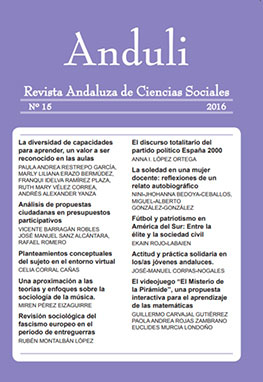
THE SOLITUDES IN THE WOMAN TEACHER: REFLECTIONS OF AN AUTOBIOGRAPHICAL STORY
DOI:
https://doi.org/10.12795/anduli.2016.i15.07Keywords:
solitudes, pedagogical practice, emancipation, creation, autobiographyAbstract
The present work is an autobiographical experience that accounts for many everyday phenomena in women teachers in Pereira, Colombia, one of them are solitude, the experience of being in the middle of many, but without feeling their presence. Here we present some general characteristics of the solitudes experienced by the teaching woman in the scope of her pedagogical practice and her personal life, understanding that it is impossible to separate one sphere from the other, with the consequences that this implies. As a methodological process, the autobiography is collected. Some conclusions lead us to think that women are still forgotten, but exploited, remembered by the male world for sexual activities, child care or for domestic work, but does not emerge as the subject that goes hand in hand to constitute new realities ; Although in the pedagogical act there is a better visualization of the woman, it does not reach to respond that feeling of solitude that accompanies them.
Downloads
References
Acaso, M. (2012). Pedagogias Invisibles: El espacio de aula como discurso. Madrid: Catarata.
Arcia, J. H. (s.f.) La conciencia del inacabamiento y el arquetipo de la individuación en Freire. Recuperado de [Internet]. [sf] Disponible en: http://www.universoarke.com/portal/articulos/136.html Arevalo Picazo, A. Mujeres y los caracoles. [Internet] [27 de julio de 2015]. Disponible en: https://mujeresylasextaorg.files.wordpress.com/2008/05/los-caracoles.pdf
Beauvoir, S. (2013). La vejez. Bogotá: Ramdom House Mondadori.
Blumenberg, H. (2011). Descripción del ser humano. Buenos Aires: Fondo de Cultura Económica.
Cardona Colorado, P. A.. Neoretórica y Hermenéutica Filosófica: Hacia una Complementariedad Analógica. [Internet] [20 de Septiembre de 2012]. Disponible en: http://repositorio.utp.edu.co/dspace/hitstream/11059/2355/1/12168C268
Díaz Gómez, A. (2013, octubre) Sujeto y subjetividad. Trabajo presentado en el seminario Persona y Sociedad de la Maestría en pedagogía y desarrollo humano. Universidad católica de Pereira, Pereira, Colombia.
Díaz, A. (2006). Formación compleja en humanidades en el ámbito de la educación superior. En publicación: La revolución contemporánea del saber y la complejidad social, ISBN 987-1183-33-X, 223-232. Disponible en:http:// bibliotecavitual.clacso.org.ar/ar/ libros/campus/soto/Colaboraciones%20Diaz%20Gomez.pdf
Dicker, G., & Terigi, F. (1997). La formacion de maestros y profesores: hoja de ruta. Buenos Aires: Paidós.
Feixas, M (2010). Enfoques y concepciones docentes en la universidad. RELIEVE, v. 16, n. 2, p. 1-27. Recuperado de http://www.uv.es/RELIEVE/v16n2/RELIEVEv16n2_2.htm
Freire, P. (2011). Pedagogía de la esperanza. México: Siglo XXI editores.
González G, M, A. (2009). Horizontes humanos: límites y paisajes. Manizales: Universidad de Manizales.
González G, M, A. (2014). Metáforas y paradojas de los miedos en los sujetos docentes. Revista Latinoamericana de Ciencias Sociales, Niñez y Juventud, 12 (1), pp. 355-370. Manizales: Universidad de Manizales.
González G, M, A. (2014A). Miedos y olvidos pedagógicos. Rosario: Editorial Homosapiens.
González G, M, A. (2016). Aprender a vivir juntos. Lenguajes para pensar diversidades e inclusiones: Noveduc.
González G, M, A. (2016A). Un preludio de sorderas. Bogotá: Editorial Oveja Negra.
González G, M, A. (2017). Amores prohibidos en Kalkan. Bogotá: Editorial Oveja Negra.
Litwin, E. (2008). El oficio de ensenar, condiciones y contextos. En E. Litwin, El oficio de ensenar, condiciones y contextos. Buenos Aires, Argentina: Paidos.
Merani, A. (1983). Carta Abierta a los Consumidores de Cultura. Barcelona: Grijalbo. Montero López, L., & Sanchez Sosa , J. J. (2001). La Soledad como Fenómeno Psicológico: Un Análisis Conceptual. Salud Mental Vol. 24 Num. 1 Febrero , pp. 19-27.
Oviedo Córdoba, M., & Cortés Polanía , R. (2007). Una Mirada a la Soledad. Neiva: Editorial Universidad Surcolombiana.
Palacio Valencia, Maria Cristina;. (2006). Cambios y transformaciones de la familia. De lo sagrado a lo secular. Un asunto de reflexion sociologica. Medellin: Departamento de estudios de familia, Universidad de Caldas.
Perrenoud, P. (2004). Desarrollar la practica reflexiva en el oficio de ensenar. Madrid: editorial Grao.
Perrenoud, P. (2011). Diez nuevas competencias para ensenar: Invitación al viaje. Bogotá: editorial Grao y Magisterio. Pinkola, C. (1995). Mujeres que corren con lobos. Barcelona: Ediciones B, S.A.
Pinkola, C. (2005). La practica de la soledad deliberada. In C. Pinkola, Mujeres que corren con Lobos (p. 411). Barcelona: B.S.A .
Polaino-Lorente. (1998). Las Depresiones infantiles. Madrid: Morata. Rancière, J. (2016). El maestro ignorante. Buenos Aires: Libros del Zorzal
Rodrigo, M.J, Rodríguez, A. & Marrero, J. (1993). Las teorías implícitas: Una aproximación al conocimiento cotidiano. Madrid: Visor distribuciones S.A.
Rossental, J. (1990). Diccionario Filosófico. Bogotá: Ed. Nacional.
Rubio Herrera , R., Cerquera Còrdoba, A. M., Muñoz Mejía, R., & Pinzón Benavides, E. A. (2011). Concepciones Populares Sobre Soledad de los Adultos Mayores de España y Bucaramanga, Colombia. Diversitas: Perspectivas en Psicología, Vol 7, Num 2, Julio - Diciembre, 307-319.
Russell, D., Peplau , L. A., & Ferguson, M. L. (1978). Developing a Messure of Loneliiness. Journal of Personality Assessment, 290-294.
Saldarriaga, O. (2003). Del oficio del maestro: practicas y teorías de la pedagogía moderna en Colombia. Bogotá: editorial Magisterio.
Sanz Hernandez, A. (2005). El Método Biográfico en la Investigación Social: Potencialidades y Limitaciones de las Fuentes Orales y los Documentos Personales. Asclepio Vol. LVII , 99-115.
N Unikel Santoncini, E. (2000). La Soledad y los introyectos de realizacion femenina. Mexico. Figura/fondo. p. 19-44.
Downloads
Published
How to Cite
Issue
Section
License
The printed and electronic editions of this Journal are published by Editorial Universidad de Sevilla, and it is necessary to cite the source in any partial or total reproduction.
Unless otherwise indicated, all contents of the electronic edition are distributed under a "Creative Commons Attribution-NonCommercial-NoDerivative 4.0 International" license. You can consult from here the informative version and the legal text of the license. This circumstance must be expressly stated in this way when necessary.
The authors who publish in this journal accept the following conditions:
1. The authors retain the copyright and assign to the journal the right of first publication, with the work registered with the license of attribution of Creative Commons, which allows third parties to use what has been published as long as they mention the authorship of the work and the first publication in this journal.
2. Authors may make other independent and additional contractual agreements for non-exclusive distribution of the version of the article published in this journal (e.g., inclusion in an institutional repository or publication in a book) as long as they clearly indicate that the work was first published in this journal.
3. Authors are allowed and encouraged to publish their work on the Internet (e.g., on institutional or personal pages) before and during the review and publication process, as this may lead to productive exchanges and greater and faster dissemination of the published work (see The Effect of Open Access).