
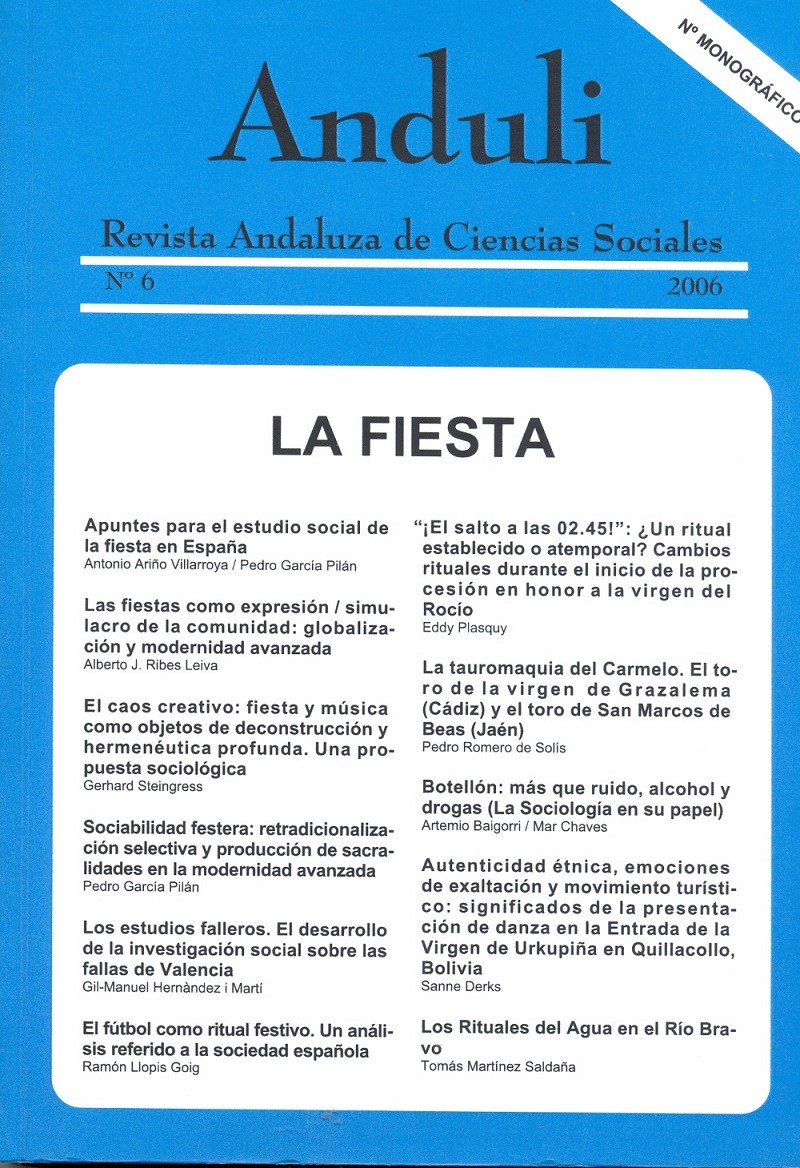
BOTELLÓN: MÁS QUE RUIDO, ALCOHOL Y DROGAS (LA SOCIOLOGÍA EN SU PAPEL)
Palabras clave:
Jóvenes, Ocio, Sociedad 24 horas, Alcohol, Botellón, Sociología AplicadaResumen
Este trabajo presenta una interpretación sistemática y actualizada de la naturaleza, dinámica y tendencias del llamado “botellón”, a la luz de las investigaciones propias y de la literatura existente. Y se expone de qué forma el abordaje del problema desde la episteme, y con el instrumental científico propio de la Sociología, ha facilitado a la sociedad española la superación de la fase de pavor social, reconduciendo el tratamiento del fenómeno a sus auténticas dimensiones; siendo en la actualidad una actividad en gran parte reglada, aunque no exenta de efectos indeseados. Con ello se recupera, y reivindica, la Sociología como instrumento esencial para el diagnóstico de los problemas sociales, la racionalización de los pavores atávicos o irracionales en general, y la definición de marcos para la intervención social.
Descargas
Citas
Alventosa L.M. (2006) “El fenómeno del «botellón» desde una óptica jurídica” en Revista Española de Drogodependencias nº 2, págs. 219-224.
Baigorri, A. (1998), “¿Paro juvenil, o estrategias de retraso en la inserción laboral?”, VI Congreso Español de Sociología, A Coruña.
Baigorri, A., Fernandez, R. et al (2001), “El botellón en las ciudades de Badajoz, Cáceres, Mérida y Plasencia”. URL: http://www.unex.es/eweb/sociolog/documentos.htm
Baigorri, A., Fernandez, R. et al (2002), “Avance de la investigación sociológica sobre el botellón”. URL: http://www.unex.es/eweb/sociolog/documentos.htm
Baigorri, A.; Fernández, R. et al (2003) Botellón: un conflicto postmoderno. Barcelona: Icaria.
Baigorri, A.; Barbolla, D.; López Rey, J.A.; Serrano, F.; Fernández Díaz, R. (2003) “Actores y percepción de las causas de botellón”. Zainak, Cuadernos de Antropología-Etnografía, nº 24, págs 887-896.
Baigorri, A. Chaves MM; Fernández, R. López Rey, J.A. (2004) “El botellón: localizando un conflicto postmoderno”. en Álvarez Sousa, coord., Turismo, ocio y Deporte, A Coruña: Ed. Universidad de A Coruña, págs 110-113.
Blanco, I. (2006) “Juventud, ocio nocturno y participación: retos para las políticas públicas locales”. Adoz: revista de estudios de Ocio, nº 30. págs, 79-84.
Borrás, F. (2004), Análisis antropológico del tiempo de ocio de la juventud en la provincia de Alicante, Alicante: Diputación Provincial de Alicante.
Botella F. et all (2004) “Carnavalización y botellón. Una etnografía estadística del ocio juvenil en la provincia de Alicante” en Turismo, ocio y Deporte, opus. cit. Sousa. Págs, 141-158.
Calafat A; et all (2005) “El consumo de alcohol en la lógica del botellón”. Revista Adicciones, vol 17 nº 3. págs 193-202.
CIS (2006) ‘Estudio 2668. Encuesta deliberativa sobre ocio juvenil nocturno. Avance de resultados’. URL: http://www.cis.es/cis/opencms/ES/Novedades/Documentacion_2668.html
Cortés, MT.; Giménez, JA.; Mestre, MV.; Nácher, MJ.; Samper, P.; Tur, A. (2005), “Los padres ante las nuevas formas de consumo de alcohol de sus hijos”, Iberpsicología. URL: http://www.fedap.es/IberPsicologia/iberpsi10/congreso_lisboa/cortes/cortes.htm
Davis, K. (1949), Human Society, Nueva York:The McMillan Company.
Elzo, J.; Laespada, M.T. Pallares, J. (2003) “Más allá del botellón: análisis socioantropológico del consumo de alcohol en los adolescentes y jóvenes”, Madrid : Agencia Antidroga de la Comunidad de Madrid.
Herrera del Rey, J.J. (2006), “Botellón, alcohol y ruido. ¿Son los Ayuntamientos, jurídicamente, responsables y competentes?”, Diario La Ley, nº 6578.
Hobbs, D., Lister, S., Hadfield, P., Winlow, S., Hall, s. (2000), “Receiving Shadows:governance and liminality in the night-time economy”, Bristish Journal of Sociology, Vol. 51, n 4, pp. 701-717.
Minardi, E. (2002), “Del giorno alla notte: organizzazione della vita notturna e nuov apportunità occupazionali”. URL: http://www.spbo.unibo.it/pais/minardi/bynight.htm
Navarrete L. et al (2003). “El fenómeno del botellón. Estudio comparado en Madrid, Galicia y Jaén”. URL: http://www.pnsd.msc.es/Categoria2/publica/pdf/ JuventudDrogodependencias4.pdf
Penn, R. (2003), “L’evoluzione dell’orario del “calcio d’inizio” nel moderno gioco del calcio. Verso un’economia politica della notte”. URL: http://www.spbo.unibo.it/pais/ minardi/penn.htm
Rodríguez-Martos, A. (2006), “The Spanish “botellón”, a particular way of bingeing”, Nordisk Alkohol- & Narkotikatidskrift , Vol. 23, pp. 137-143.
Salaün, S., Etienvre, F, (2006), comp., Ocio y ocios. Du loisir aux loisirs (es-pagne, XVIIIeXXe siècles), Paris: Centre de Recherche sur l’Espagne Con-temporaine.
Sánchez Pardo, L. (2002), Los padres ante el botellón. Una guía práctica para una diversión sana de los hijos, Valencia: Fundación para el Análisis, Estudio y prevención de las Drogodependencias.
Vivas, M.F., Carreto, Mª A., Gimeno, A. (2002), Drogas y adolescentes, Badajoz: Diputación de Badajoz.
Descargas
Publicado
Cómo citar
Número
Sección
Licencia
Las ediciones impresa y electrónica de esta Revista son editadas por el Editorial Universidad de Sevilla, siendo necesario citar la procedencia en cualquier reproducción parcial o total.
Salvo indicación contraria, todos los contenidos de la edición electrónica se distribuyen bajo una licencia de uso y distribución “Creative Commons Atribución-NoComercial-SinDerivar 4.0 Internacional”  Puede consultar desde aquí la versión informativa y el texto legal de la licencia. Esta circunstancia ha de hacerse constar expresamente de esta forma cuando sea necesario.
Los autores/as que publiquen en esta revista aceptan las siguientes condiciones:
- Los autores/as conservan los derechos de autor y ceden a la revista el derecho de la primera publicación, con el trabajo registrado con la licencia de atribución de Creative Commons, que permite a terceros utilizar lo publicado siempre que mencionen la autoría del trabajo y a la primera publicación en esta revista.
- Los autores/as pueden realizar otros acuerdos contractuales independientes y adicionales para la distribución no exclusiva de la versión del artículo publicado en esta revista (p. ej., incluirlo en un repositorio institucional o publicarlo en un libro) siempre que indiquen claramente que el trabajo se publicó por primera vez en esta revista.
- Se permite y recomienda a los autores/as a publicar su trabajo en Internet (por ejemplo en páginas institucionales o personales) antes y durante el proceso de revisión y publicación, ya que puede conducir a intercambios productivos y a una mayor y más rápida difusión del trabajo publicado (vea The Effect of Open Access).