
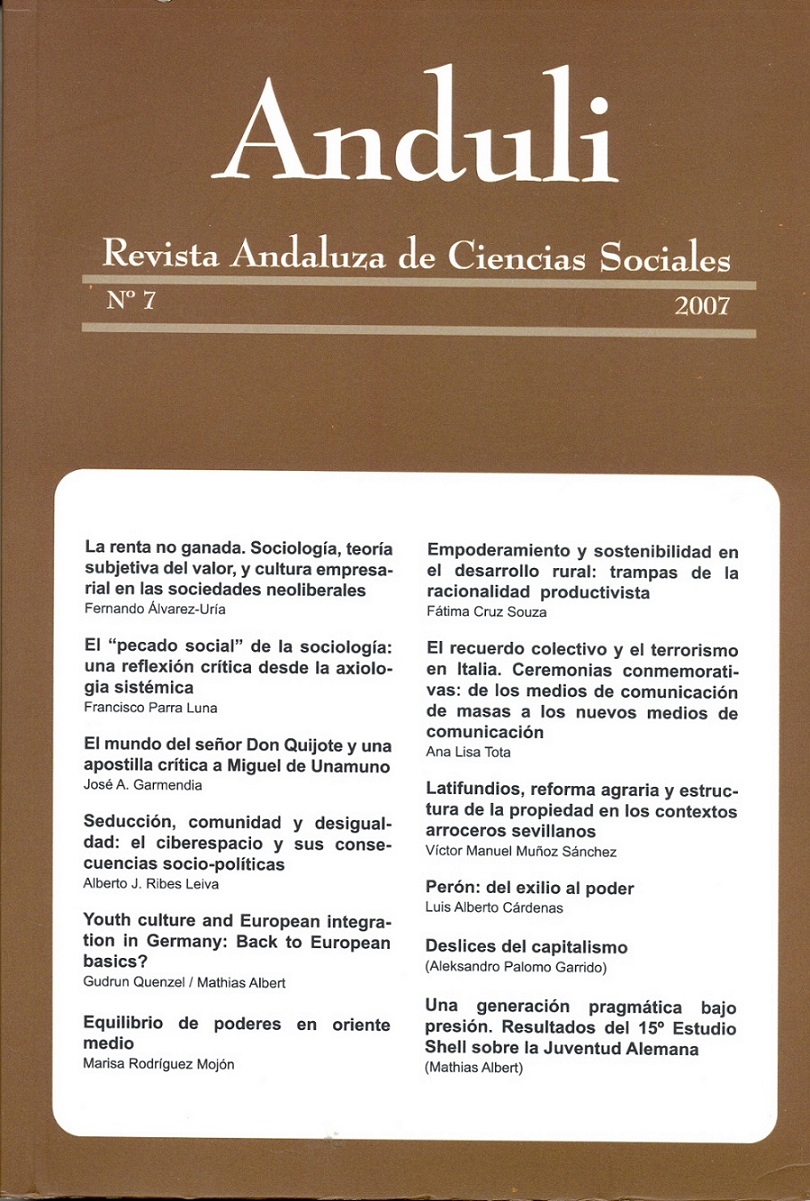
THE "SOCIAL SIN" OF SOCIOLOGY: A CRITICAL REFLECTION FROM SYSTEMIC AXIOLOGY
Abstract
How can Social Science, and particularly Sociology, disregard the very reasons why people live together in societies or associations? How can it forget that social organizations must not and cannot produce anything but the values people pursue? How not to account for or measure the levels achieved for these values and use the results to substantiate accurately any kind of criticism? Or how can the ethical dimension of such an oversight be forgotten and show no consideration for what the system does for the people since, after all, it is the people who pay. Above all, how can one abandon the most genuinely sociological perspective, which consists precisely in seeing what the system does through the eyes of “the man in the street? Do we by chance not know that what every person wants in whatever society, be it large or small, primitive or advanced, is “a better life”? And, do we not know that the unit of analysis for achieving this purpose is “an integrated system of values” (compatible levels of health, wellbeing, security, equity freedom, an unpolluted environment, social prestige, etc.) and that it is for this and only this reason that people associate and cooperate? So why are the “value systems” produced by any kind of society, the reasons which justify their existence, from the family to the Nation-State, not taken into account, recorded, measured and compared systematically and routinely? How is it that no social science- and less so Sociology- gauges the “values system” achieved by society for the general benefit of the individuals which comprise it? These are the question addressed in this paper.Downloads
Downloads
Published
How to Cite
Issue
Section
License
The printed and electronic editions of this Journal are published by Editorial Universidad de Sevilla, and it is necessary to cite the source in any partial or total reproduction.
Unless otherwise indicated, all contents of the electronic edition are distributed under a "Creative Commons Attribution-NonCommercial-NoDerivative 4.0 International" license. You can consult from here the informative version and the legal text of the license. This circumstance must be expressly stated in this way when necessary.
The authors who publish in this journal accept the following conditions:
1. The authors retain the copyright and assign to the journal the right of first publication, with the work registered with the license of attribution of Creative Commons, which allows third parties to use what has been published as long as they mention the authorship of the work and the first publication in this journal.
2. Authors may make other independent and additional contractual agreements for non-exclusive distribution of the version of the article published in this journal (e.g., inclusion in an institutional repository or publication in a book) as long as they clearly indicate that the work was first published in this journal.
3. Authors are allowed and encouraged to publish their work on the Internet (e.g., on institutional or personal pages) before and during the review and publication process, as this may lead to productive exchanges and greater and faster dissemination of the published work (see The Effect of Open Access).