
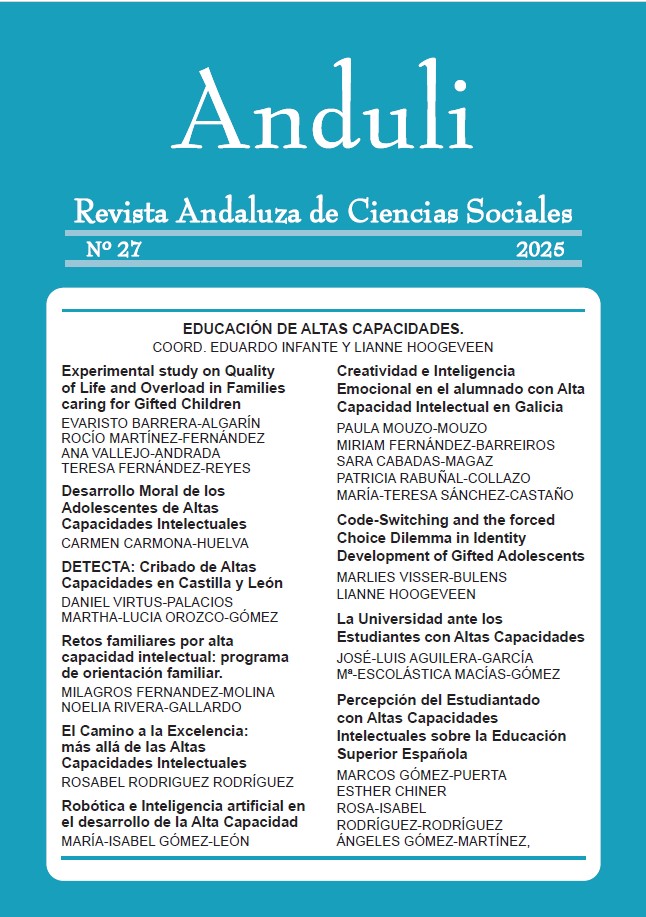
Experimental study on Quality of Life and Overload in families caring for gifted children
DOI:
https://doi.org/10.12795/anduli.2025.i27.01Palabras clave:
Altas Capacidades, Conciliación, Calidad de vida, Actividades extraescolares, SobrecargaResumen
The scientific literature and previous research show that families of gifted children tend to compensate for the deficits in meeting the educational needs of the group, making use of a multitude of resources and extracurricular activities. The objective of this study is to quantify and measure the amount of these curricular activities and their impact on the quality of life of families of gifted children compared to families of non-gifted children. The methodology is a survey experiment involving 160 families in Seville: 80 families with gifted children (experimental group) and 80 families with non-gifted children (control group). The results show that gifted children attend almost twice as many extracurricular activities per week as their non-gifted peers, and the cost to their families is four times higher. This is perceived by mothers of gifted children as detrimental to their quality of life and overburdens their free time, as measured by the GENCAT and ZARIT scales.
Descargas
Citas
Agudo, N. (2017). A student with high abilities in my classroom, Now what? Revista Nacional e Internacional de Educación Inclusiva, 10, 265-277.
Alencar, E. (2008). Social-emotional difficulties of the student with high abilities. Revista de Psicología, 26, 43-62. https://doi.org/10.18800/psico.200801.003
Alkhawaldeh M.A., Alwaely S.A., Al Sabi Y.N., Abueita S.D., Alomari N., Al Taqatqa F.A.S., Khasawneh M.A.S., Darawsheh S.R., & Al-Shaar A.S.h (2023). Parents’ Role in Gifted Students’ Educational Issues and Development. Information Sciences Letters, 12(3), 1215-1221. https://doi.org/10.18576/isl/120312
Artiles, C., & Jiménez, J.E. (2005) Identificación e intervención educativa y familiar con el alumnado de altas capacidades intelectuales. Las Palmas de Gran Canaria: Universidad de Las Palmas de Gran.
Barrera, A., Durán, R., González, J., & Reina, C. (2008). Handbook for students with specific educational support needs due to their high intellectual capacity.Spain: Junta de Andalucía,
Barrera, L., Sánchez, B., & Carrillo, G. (2013). The burden of caregiving for chronically ill children. Revista Cubana de Enfermería, 29, 39-47.
Bazán, A., Sánchez, B., & Castañeda, S. (2007). Structural relationship among parents’ support, parent’s educational level, characteristics of the teacher and child’s achievement in reading and writing. Revista Mexicana de Investigación Educativa, 3, 701-729.
Burke, R., & Greenglass, E. (1999). Work-family conflict, spouse support and nurse-staff wellbeing during organizational restructuring. Journal of Occupational Health Psychology, 4, 327-336. https://doi.org/10.1037/1076-8998.4.4.327
Busseri, M., Rose-Krasnor, L., Willoughby, T., & Chalmers, H. (2006). A longitudinal examination of breadth and intensity of youth activity involvement and successful development. Developmental Psychology, 42, 1313-1326.10.1037/0012-1649.42.6.1313 https://doi.org/10.1037/0012-1649.42.6.1313
Callahan, C., & Hertberg-Davis, H. (2012). Fundamentals of gifted education: considering multiple perspectives.Routledge. https://doi.org/10.4324/9780203848173
Cano, I. (2002). Students with high intellectual capacities: Intervention proposal. Spain: Universidad internacional de la Rioja.
Casino-García, A. M., Llinares-Insa, L., Guillén-Martín, V. M., & Ibáñez-García, A. (2024). Giftedness and Family Well-being: The Role of Emotional Intelligence, Perceived Social Support and Stres. Psicothema, 36(3), 277-286. https://doi.org/10.7334/psicothema2023.401
Codina, N., Pestana, J., Castillo, I., & Balaguer, I. (2016). The girls to study and dance, the boys do sport: A study of the extracurricular activities of teenagers through time budgets. Cuadernos de Psicología del Deporte, 16, 233-242.
Corbalán, J., & Limiñana, R. M. (2010). The genie in a bottle. The CREA test, questions and creativity. Introduction to special theme “The CREA test, creative intelligence”. Annals of Psychology, 26, 197-205. http://dx.doi.org/10.6018/analesps
Cotes, S., & Gómez, M. (2009). Theory of Multiple Intelligences: A Contribution to Higher Education. Academia Libre,7, 29-35.
Darling, N. (2005). Participation in extracurricular activities and adolescent adjustment: Cross-sectional and longitudinal findings. Journal of Youth and Adolescence, 34, 493-505. https://doi.org/10.1007/s10964-005-7266-8
Denault, A., & Poulin, F. (2009). Intensity and breadth of participation in organized leisure: What is important to consider when it comes to youth adjustment?. Journal of Youth and Adolescence, 38, 1199-1213. https://doi.org/10.1007/s10964-009-9437-5
Domingo, J. (1998). Collaboration between families and professionals in the education of students with special educational needs. In Peñafiel, F., Domingo, J. Fernández, J. &Navas, J.(Eds.), How to intervene in Special Education. Case practice resolution (pp. 125-140). Adhara.
Eccles, J., Barner, B., Stone, M., & Hunt, J. (2003). Extracurricular activities and adolescent development. Journal of Social Issues, 59, 865-890. https://doi.org/10.1046/j.0022-4537.2003.00095.x
Fernández,M.T. and Sánchez, M.T. (2010). Cómo detectar y evaluar a los alumnos con altas capacidades intelectuales [How to detect and evaluate students with high intellectual abilities]. Madrid: MAD Ediciones.
Fredericks, J., & Eccles, J. (2006). Is extracurricular activity participation associated with beneficial outcomes? Concurrent and longitudinal relations. Developmental Psychology, 42, 698-713. https://doi.org/10.1037/0012-1649.42.4.698
Gardner. H. (2008). Multiple Intelligences: New Horizons in Theory and Practice. New York: Basics Books.
Gamboa, M., García, Y., & Beltrán, M. (2013). Pedagogical and didactic strategies for the development of multiple intelligences and autonomous learning. Revista de Investigaciones UNAD, 12, 101-128. https://doi.org/10.22490/25391887.1162
Golle, J., Schils, T., Borghans, L., & Rose, N. (2023). Who Is Considered Gifted From a Teacher’s Perspective? A Representative Large-Scale Study. Gifted Child Quarterly, 67(1), 64 – 79. https://doi.org/10.1177/00169862221104026
Hermoso, Y. (2009). Study of the free time occupation of the school population and its participation in extracurricular activities. Spain: Universidad de Málaga.
Higueras-Rodríguez, L., & Fernández-Gálvez, J. (2017). The role of the family in the education of children with high intellectual capacities. International Journal of Educational Research and Innovation, 7, 149-163.
INICO (2020). Escala de Calidad de Vida GENCAT. Descarga de la aplicación. https://inico.usal.es/27/instrumentos-evaluacion/escala-de-calidad-de-vida-gencat.aspx
Kaufman, A.S. & Kaufman, N.L (2004).Use KBIT-2 to measure verbal and nonverbal cognitive ability.Bloomington, MN: Pearson.
Larivée, S. (2010). Gardner's Multiple Intelligences: Discovery of the Century or Simple Political Righteousness? Revista Mexicana de Investigación en Psicología, 2, 115-126. https://doi.org/10.32870/rmip.vi.483
Larson, R., Hansen, D., & Moneta, G. (2006). Differing profiles of developmental experiences across types of organized youth activities. Developmental Psychology, 42, 849-863. https://doi.org/10.1037/0012-1649.42.5.849
Mahoney, J. (2000). School extracurricular activity participation as moderator in the development of antisocial partners. Child Development, 71, 501-516. https://doi.org/10.1111/1467-8624.00160
Matthews, M., Jolly, J., Makel, M., Almhawes, A., Daniels, K. & Wojciechowski, J. (2024). Considerations of Academically Talented Students’ Homeschooling Families for Returning to Traditional Schools. Gifted Child Quarterly, 68 (2), 137-153. https://doi.org/10.1177/00169862231222210
Meroño, L., Calderón, A., & Hastie, P. (2015). Effect of an intervention based on the Sports Education model on psychological variables in federated swimmers. Cuadernos de Psicología del Deporte, 15, 35-46. https://doi.org/10.4321/S1578-84232015000200005
Ministry of Education, Culture and Sport. (2015). Sports Habits Survey 2015.Ministerio de Educación, Cultura y Deporte. Retrieved fromhttps://sede.educacion.gob.es/publiventa/d/20497C/19/0
Muñoz, M., & Ayuso, M. (2014). Multiple Intelligences, Eight Different Ways to Learn?.Escuela Abierta: Revista de Investigación Educativa,17, 103-116. https://doi.org/10.29257/EA17.2014.07
Pedraza, A., Rodríguez-Martínez, C., & Acuña, R. (2013). Initial validation of a scale to measure the level of overburdening of parents or caregivers of asthmatic children. Biomédica, 33, 361-369.
Peebles, J.L., Mendaglio, S. & McCowan, M. (2023). The Experience of Parenting Gifted Children: A Thematic Analysis of Interviews With Parents of Elementary-Age Children. Gifted Child Quarterly, 67(1), 18-27. https://doi.org/10.1177/00169862221120418
Pérez, L. (2006). Alumnado con capacidad superior. Experiencias de intervención educativa. Madrid: Editorial Síntesis.
Pham, T., & Altman, C. E. (2024). An Analysis of Individual, Parental, and Family Determinants of Gifted Placement among Children of Immigrants – Evidence from the 2014 SIPP Data. Journal of Child and Family Studies. https://doi.org/10.1007/s10826-024-02802-5
Ponce de León, A., Sanz, E., & Valdemoros, M. (2015). Family leisure and physical activity in high school students: alliance, rivalry, or independence?.Pedagogía Social. Revista Interuniversitaria, 25, 51-68. https://doi.org/10.7179/PSRI_2015.25.03
Post, G. (2024). Resilient parents; resilient kids: How parental self-awareness is critical to helping smart kids thrive. Gifted Education International, 0(0). https://doi.org/10.1177/02614294241274442
Raven, J., Raven, J. C., & Court, J. H. (1998). Manual for Raven’s progressive matrices and vocabulary scales. Section 1: General overview.Oxford: Oxford Psychologists Press.
Renati, R., Bonfiglio, N.S., Mascia, M.L. & Penna, M.P. (2023). Gifted Children through the Eyes of Their Parents:Talents, Social-Emotional Challenges, and Educational Strategies from Preschool through Middle School. Children, 10,(1), https://doi.org/10.3390/children10010042
Reynolds, R. & Kamphaus, C. (2003). Reynolds intellectual assessment scales and Reynolds intellectual screening test professional manual. Psychological assessment resources.
Romo, M., Alfonso-Benlliure, V., & Sanchez-Ruiz, M. J. (2016). El test de creatividad infantil (TCI): evaluando la creatividad mediante una tarea de encontrar problemas. Psicología Educativa, 22, 93-101. https://doi.org/10.1016/j.pse.2016.01.005
Sánchez, A., & Baena, M. (2017). Identification of the student with high intellectual capacities: responsibility of the teacher or of the department of educational and psychopedagogical orientation?.Aula de Encuentro, 1, 69-91.
Seguí, J., Ortiz-Tallo, M., & De Diego, Y. (2008). Factors associated with the stress of the primary caregiver of children with autism: Overload, psychopathology and state of health. Anales de Psicología, 24, 100-105. http://dx.doi.org/10.6018/analesps
Sicilia, A. (1998). Extracurricular activity, physical education and cirriculum. In Santos, M. & Sicilia, A. (Ed.), Extracurricular Physical Activities: An Alternative Approach (pp. 19-44). Inde.
Silva, M.S., Santos, M.J.S. & Barbeiro, L.F. (2024). Once upon a time … creative writing in children referred for a diagnosis of giftedness. Revista Conhecimento Online, 2, 89-103. https://doi.org/10.25112/rco.v2.3854
Soriano, E. (2008). Social-emotional difficulties of students with high skills. Revista de Psicología, 26, 43-62. https://doi.org/10.18800/psico.200801.003
Souza, D., Muniz R., & Vilarinho-Pereira, D (2023). Supporting and guiding families of gifted children: The role of a psychoeducational program. Gifted and Talented Internationa, 38 (1),12 – 20. https://doi.org/10.1080/15332276.2023.2238798
Souza, D., Vilarinho-Pereira, D., & Muniz R (2024). Voices From the Families: Strategies for and Challenges in Raising a Gifted Child. Journal for the Education of the Gifted, 47(2), 162 – 181. https://doi.org/10.1177/01623532241235576
Sreenidhi, S K, & Helena, T.C. (2017). Multiple intelligence assessment - based on Howard Gardner’s research. International Journal of Scientific and Research Publications¸ 7, 213-222.
Sternberg, R. (2024). Individual, collective, and contextual aspects in the identification of giftedness. Gifted Education International, 40 (1), 3–24. https://doi.org/10.1177/02614294231156986
Suárez, J., Maiz, F., & Meza, M. (2010). Multiple intelligences: A pedagogical innovation to enhance the process of teaching and learning. Investigación y Postgrado, 25, 81-94.
Thurstone, L. L., & Yela, M. (2012). Test de percepción de diferencias (caras-r). Madrid: Tea Ediciones.
Torregrosa, D., Belando, N., & Moreno-Murcia, J. (2014). Prediction of life satisfaction in healthy exercise practitioners. Cuadernos de Psicología del Deporte, 14, 117-122. https://doi.org/10.4321/S1578-84232014000100014
Varela, L., Varela, L., & Lorenzo, J. (2016). The school and the conciliation of the daily times of the families of the pupils of primary education in Galicia. Bordón Revista de Pedagogía, 68, 179-194.https://doi.org/10.7458/SPP2018879498
Verdugo, M., Schalock, R., Gomez, L., & Arias, B. (2007). Construction of multidimensional Quality of Life scales centred on context: the GENCAT Scale. Siglo Cero, 38, 57-72.
Vialle, W. (2017). Supporting giftedness in families: a resources perspective. Journal for the Education of the Gifted, 40(4), 372–393. https://doi.org/10.1177/0162353217734375
Wechsler, D. (2014). Wechsler intelligence scale for children-fifth edition. Bloomington, MN: Pearson. https://doi.org/10.1037/t79359-000
World Health Organization (2005). Mental health, facing the challenges, building solutions. Report from de WHO European Ministerial Conference. World Health OrganizationRegional Office for Europe. Retrieved fromhttp://www.euro.who.int/__data/assets/pdf_file/0008/96452/E87301.pdf
Vuyk, A., Montania, M., Barrios, L., & Lobo, M. (2024). Gifted education in Paraguay: analyses from a learning-resource perspective. Cogent Education, 11(1). https://doi.org/10.1080/2331186X.2024.2332863
World Health Organization(2010). Global recommendations on physical activity for health. World Health Organization Regional Office for Europe: Retrieved fromhttps://www.who.int/dietphysicalactivity/factsheet_recommendations/en/
Yildiz, S. & Altay, N. (2024). Gifted children and their peers perceived parental attitudes, psychosocial problems and quality of life. European Journal of Clinical and Experimental Medicine, 22(2), 353-361. https://doi.org/10.15584/ejcem.2024.2.21
Yuste,C. (2018). IGF-2r. Manual Técnico: Revisado. Giuntieos: Psychometrics SL.
Zanetti, M.A., Trombetta, T., Rollè, L., & Marinoni, C. (2024). Family Functioning and Internalizing and Externalizing Problems in Gifted Children. European Journal of Investigation in Health, Psychology and Education,14 (5), 1171-1181. https://doi.org/10.3390/ejihpe14050077
Descargas
Publicado
Cómo citar
Número
Sección
Licencia
Derechos de autor 2024 ANDULI. Revista Andaluza de Ciencias Sociales

Esta obra está bajo una licencia internacional Creative Commons Atribución-NoComercial-CompartirIgual 4.0.
Las ediciones impresa y electrónica de esta Revista son editadas por el Editorial Universidad de Sevilla, siendo necesario citar la procedencia en cualquier reproducción parcial o total.
Salvo indicación contraria, todos los contenidos de la edición electrónica se distribuyen bajo una licencia de uso y distribución “Creative Commons Atribución-NoComercial-SinDerivar 4.0 Internacional”  Puede consultar desde aquí la versión informativa y el texto legal de la licencia. Esta circunstancia ha de hacerse constar expresamente de esta forma cuando sea necesario.
Los autores/as que publiquen en esta revista aceptan las siguientes condiciones:
- Los autores/as conservan los derechos de autor y ceden a la revista el derecho de la primera publicación, con el trabajo registrado con la licencia de atribución de Creative Commons, que permite a terceros utilizar lo publicado siempre que mencionen la autoría del trabajo y a la primera publicación en esta revista.
- Los autores/as pueden realizar otros acuerdos contractuales independientes y adicionales para la distribución no exclusiva de la versión del artículo publicado en esta revista (p. ej., incluirlo en un repositorio institucional o publicarlo en un libro) siempre que indiquen claramente que el trabajo se publicó por primera vez en esta revista.
- Se permite y recomienda a los autores/as a publicar su trabajo en Internet (por ejemplo en páginas institucionales o personales) antes y durante el proceso de revisión y publicación, ya que puede conducir a intercambios productivos y a una mayor y más rápida difusión del trabajo publicado (vea The Effect of Open Access).