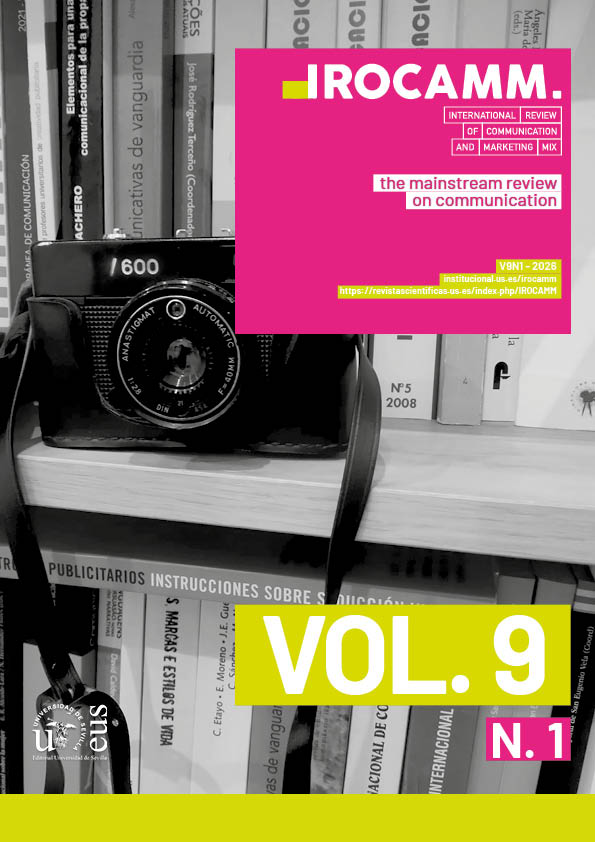
Scientific photography
Communication strategies and ethical challenges for its dissemination in digital environments
DOI:
https://doi.org/10.12795/IROCAMM.2026.v09.i01.03Keywords:
Comunicación científica, Ética de la información, Información científica, Medios digitales, Redes sociales, Recnología de la informaciónAbstract
This study analyses the role of scientific photography as a communication tool in digital environments, as well as the ethical challenges that arise from its production, dissemination and reception. Using a mixed concurrent design, 412 surveys and 12 semi-structured interviews were collected from students, teachers, researchers, and institutional communication managers. The quantitative results show significant differences between students and teachers in terms of use, perceived credibility, associated ethical risks, and intention to disseminate scientific images. Factor analysis revealed three main dimensions: attitudes towards visual dissemination, perception of credibility, and institutional support. Qualitative findings, meanwhile, highlight the importance of images as a means of academic visibility, concerns about decontextualisation, and the lack of clear institutional guidelines. The integration of both approaches indicates that the intention to disseminate depends on formative, attitudinal, and ethical factors, and that institutions need to strengthen policies, training, and support in scientific visual communication. The study concludes that scientific photography has high dissemination potential, but its responsible use requires solid ethical frameworks and communication skills in line with the contemporary digital ecosystem.
Downloads
References
AE Comunicación Científica. (2021). La Comunidad Científica ante el uso de la Imagen en la Comunicación Científica. https://aecomunicacioncientifica.org/wp-content/uploads/2021/04/guia-de-actuacion-2020imagencientifica.pdf
Blanco Pérez, M. (2022). La fotografía entre estudiantes de periodismo y comunicación audiovisual de las universidades públicas andaluzas: consumo, cultura visual y una propuesta pedagógica. Kepes, 19(25), 47-77. https://doi.org/10.17151/kepes.2022.19.25.3
Collado Alonso, R., Alvarado López, M. C., de Andrés del Campo, S.; & Pereira, S. (2024). Ética de la imagen y menores. Un análisis de las publicaciones en Facebook de organizaciones no gubernamentales (ONG) dedicadas a la infancia. Revista de Comunicación, 23(1), 157–175. https://doi.org/10.26441/RC23.1-2024-3443
Elías-Zambrano, R., Martín-García, A., Fernandez-Osso Fuentes, M. (2025). Consecuencias del uso de las redes sociales en consumidores nativos. Revisión de elementos de interacción a través de la publicidad digital y la educomunicación como respuesta. Cuadernos del Audiovisual del Consejo Audiovisual de Andalucía, 13, 124-140. https://doi.org/10.62269/cavcaa.44
Gallardo-Camacho, J.; Melendo Rodríguez-Carmona, L.; & Presol-Herrero, Á. (2023). Divulgación y representación de contenidos audiovisuales científicos en la red social TikTok. Fotocinema. Revista científica de cine y fotografía, 27, 9–32. https://doi.org/10.24310/Fotocinema.2023.vi27.16334
García López, J. (2024). Epicuro y la publicidad: Comunicación, consumo y felicidad. IROCAMM - International Review Of Communication And Marketing Mix, 7(2), 9–25. https://doi.org/10.12795/IROCAMM.2024.v07.i02.01
González Bengoechea, A. (2020). El impacto del uso de la imagen en la cuenta de Twitter de CSIC. ICONO 14. Revista científica de Comunicación y Tecnologías emergentes, 18(1), 205–230. https://doi.org/10.7195/ri14.v18i1.1273
Gurieva, N., Villagómez, C., Saldaña, J.C., & Ríos Alanís, J.J. (2021). Entre la ciencia y el arte: evolución de la fotografía. Revista Interior Gráfico, 17. https://acortar.link/OSn3iV
Hartmann, J.; Exner, Y.; & Domdey, S. (2025). The power of generative marketing: Can generative AI create superhuman visual marketing content? International Journal of Research in Marketing, 42(1), 13-31. https://doi.org/10.1016/j.ijresmar.2024.09.002
Jiménez-Marín, G.; Sanz-Marcos, P.; Tobar-Pesántez, L. (2021). Keller's resonance model in the context of fashion branding: Persuasive impact through the figure of the influencer. Academy of Strategic Management Journal, 20(6), 1-14. https://acortar.link/Mr06sB
Lee, P.-S., West, J. D., & Howe, B. (2016). Viziometrics: Analyzing visual information in scientific literature. PLOS ONE, 11(5), e0155345. https://doi.org/10.1371/journal.pone.0155345
LimeSurvey. (2024). Calcula tu tamaño de muestra perfecto ahora. https://acortar.link/J7RvMN
López-Roldán, P., & Fachelli, S. (2017). Metodología de la investigación social.Universidad Autónoma de Barcelona.
Lima Suárez, S.J.; & Vargas Soraca, G. (2020). Redes sociales como estrategia académica en la educación superior: ventajas y desventajas. Educación y educadores, 23(4), 559-574. https://doi.org/10.5294/edu.2020.23.4.1
Masterclass Photographers. (2025). Fotografía científica: técnicas, aplicaciones y herramientas. https://masterclassphotographers.com/blog/fotografia-cientifica/
Microbacterium. (2024). 4 Ventajas y riesgos de la divulgación científica en redes sociales. https://acortar.link/XDthNK
Mohamed, K. M. M. (2025). Visual storytelling and cultural connection in social media advertising. Frontiers in Communication, 10, 1-15. https://doi.org/10.3389/fcomm.2025.1584156
Ordóñez Castillo, G.A.; Montesdeoca Estrada, S.J.; Henríquez Mendoza, E.F.; Santín Picoita, F.G.; Granda Cruz, C.A. (2024). Divulgación científica y plataformas digitales. Estudios y Perspectivas, 4(3), 3146-3166. https://doi.org/10.61384/r.c.a..v4i3.602
Oviedo, L. (2024). La evolución de la fotografía: avances tecnológicos revolucionarios. Historia OVH. https://acortar.link/548v1A
Papí-Gálvez, N. (2020). A falta de un clic. Hacia una propuesta de modelo afectivo en planificación de medios. IROCAMM - International Review Of Communication And Marketing Mix, 3(2), 7–21. https://dx.doi.org/10.12795/IROCAMM.2020.v02.i03.01
Qualtrics. (2024). Cómo calcular el tamaño de una muestra. https://acortar.link/FbPOvr
Ramos Chávez, H.A. (2024). La información en las redes sociales digitales y sus riesgos en la formación de comportamientos, creencias y actitudes ciudadanos. Investigación bibliotecológica, 38(101), 109-124. https://doi.org/10.22201/iibi.24488321xe.2024.101.58933
Rana, K., & Chimoriya, R. (2025). A Guide to a Mixed-Methods Approach to Healthcare Research. Encyclopedia, 5(2), 51. https://doi.org/10.3390/encyclopedia5020051
Romero Borges, R.; Rojas Machado, N.; Zapata Pérez, Y.; Medina Aguilera, C.M. & Romero Borges, R. (2019). Las redes sociales académicas y su vinculación con las investigaciones biomédicas. Medicentro Electrónica, 23(4), 354-367. http://scielo.sld.cu/scielo.php?script=sci_arttext&pid=S1029-30432019000400354
Sánchez-Vigil, J. M., Salvador-Benítez, A., & Olivera-Zaldua, M. (2021). Producción científica sobre fotografía en las revistas de Documentación (2000–2019). Revista Española de Documentación Científica, 44(1), e287. https://doi.org/10.3989/redc.2021.1.1749
Santos, M. (2025). Fotografía científica: técnicas, aplicaciones y herramientas. Masterclass Photographers. https://acortar.link/WOZ5BU
Spierings, N., & Geurts, N. (2025). Mixed methods, mixed feelings: a review of hurdles faced and vaulting poles to apply when wanting to do and publish mixed methods research. Journal of Ethnic and Migration Studies, 51(12), 3170–3191. https://doi.org/10.1080/1369183X.2025.2487748
Storey, M. A., Hoda, R., Maciel Paz Milani, A., & Baldassarre, M. T. (2025). Guiding principles for mixed methods research in software engineering. Empirical Software Engineering, 30(5), 138. https://doi.org/10.1007/s10664-025-10629-x
Subedi, M. (2023). Use of Mixed Methods in Social Sciences Research. Nepalese Journal of Development and Rural Studies, 20(1), 96-105. https://doi.org/10.3126/njdrs.v20i01.64166
Utari, D., Susetyo, D. & Maulana, A. (2025). The influence of visual content on social media on Generation Z purchasing decisions with brand engagement as an intervening variable. Journal of International Conference Proceedings, 7(5), 1129–1143. https://doi.org/10.32535/jicp.v7i5.3638
Downloads
Published
How to Cite
Issue
Section
License
Copyright (c) 2026 IROCAMM - International Review Of Communication And Marketing Mix

This work is licensed under a Creative Commons Attribution-NonCommercial-ShareAlike 4.0 International License.
International Review Of Communication And Marketing Mix provides unrestricted access to its contents from the moment of publication in this electronic edition, and is therefore an open-access magazine. The originals published in this magazine are the property of the University of Seville and it is obligatory to cite their origin in any total or partial reproduction.' All content is distributed under a Creative Commons Attribution 4.0 (CC BY-NC-ND 4.0) license. This should be expressly stated in this way where necessary. You can consult the informative version and the legal text of the license.
The authors who publish in this journal agree to the following terms:
- The assignment of rights is made under the Creative Commons license.
- Authors may separately make additional arrangements for the non-exclusive distribution of the version of the work published in the journal (for example, placing it in an institutional repository or publishing it in a book), with an acknowledgement of its initial publication in this journal.
- Authors are allowed and encouraged to disseminate their work electronically (e.g. in institutional repositories or on their own website) before and during the submission process, as this can lead to productive exchanges, as well as earlier and more extensive citation of published work.
- The dissemination of the articles will be carried out on general social networks, ResearchGate, Mendeley, Academia.edu, Cosis, e-lis and other databases or full text repositories on the Internet with whom the journal establishes an agreement for their dissemination and visibility.
- Copyright is of two kinds: moral rights and economic rights. Moral rights are perpetual prerogatives, unrenounceable, untransferable, inalienable, unattachable and imprescriptible. Economic rights refer to the benefits obtained by the use or disclosure of the works. IROCAMM - International Review of Communication And Marketing Mix is exclusively authorized to make or authorize by any means the use, distribution, dissemination, reproduction, adaptation, translation or transformation of the work.
International Review Of Communication And Marketing Mix does not charge fees for submission of papers, nor does it charge fees for publication of its articles.