
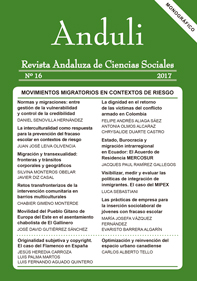
STATE, BUREAUCRACY AND INTRAREGIONAL MIGRATION IN ECUADOR. The MERCOSUR ResidenceAgreement
DOI:
https://doi.org/10.12795/anduli.2017.i16.07Keywords:
State, migrants, Mercosur visa, legality and extralegalityAbstract
The paper examines the implementation of the Mercosur Residency Agreement in the Republic of Ecuador
using an ethnographic analysis of the State and its interaction with immigrants who have applied for residency via this instrument, popularly known as the ‘Mercosur visa’. Theoretically, this case is
analyzed from the perspective of the anthropology of the State, understanding the relationship between system-State and idea-State, which acquires tangible form in daily bureaucratic practices. The article analyzes these bureaucratic practices in the cities of Quito, Guayaquil and Lago Agrio.
Downloads
References
Acosta, D. (2018). The legal construction of the national and the foreigner in South America since Independence. 200 years of migration and citizenship law. Cambridge University Press (en prensa).
Abélès, M. (1990). Anthropologie de l’Etat. Paris, Armand Colin. http://www.armand-colin.com/anthropologie-politique-9782200250386 (Revisado el 2 de julio del 2017).
Abrams, P. (2015). Notas sobre la dificultad de estudiar el estado. En Abrams P, Gupta A., Mitchel, T. Antropología del Estado. Ciudad de México: Fondo de Cultura Económica.
Ackerman, A. (2014). La ley, el orden y el caos: construcción social del Estado y el inmigrante en Ecuador. Quito: Instituto de Altos Estudios Nacionales.
Alonso, A. (2012). Integración y migraciones. El tratamiento de la variable migratoria en el MERCOSUR y su incidencia en la política argentina. Cuaderno Migratorio No. 3. Buenos Aires: OIM. https://robuenosaires.iom.int/sites/default/files/publicaciones/Cuadernos_Migratorios_3__Integracion_y_migraciones.pdf. (Revisado el 28 de marzo del 2016)
Bourdieu, P. (2002). Espírito de Estado: génesis y estructura del campo burocrático. Revista Sociedad, UBA, pp. 1-16. http://www.unsam.edu.ar/revistasacademicas/index.
php/etnocontemp/article/view/210/295 ( Revisado 8 de enero del 2017).
Domenech, E. (2013). Las migraciones son como el agua: hacia la instauración de políticas de control con rostro humano. Polis, 35, http://polis.revues.org/9280 (Revisado 15 de enero del 2017).
Foucault, M. (1991). La Gubernamentalidad, VV AA, Espacios de poder, Madrid, La Piqueta, pp: 9 a 26 https://es.scribd.com/document/111254596/
Foucault-La-Gubernamentalidad (Revisado 13 de enero del 2018)
Gil, S. (2009). Interrogar al Estado desde la inmigración. En Domenech Eduardo (comp.) Migración y políticas: El Estado interrogado. Procesos actuales en Argentina y Sudamérica. Córdoba: Universidad de Córdoba, 13-20. https://www.aacademica.org/eduardo.
domenech/34.pdf (Revisado 4 de febrero del 2011).
Gil, S., Santi, S., & Jaramillo V. (2017). Políticas de migración familiar, desplazamientos de fronteras y control migratorio deslocalizado: nuevos instrumentos para el gobierno (a distancia) de la migración en la Unión Europea. En Ramírez Jacques. (coord.) Migración, Estado y Políticas. La Paz: Vicepresidencia de Bolivia – CELAG, 197-213.
Gupta, A. (2006). Blurred Boundaries: The Discourse of Corruption, the Culture of Politics and Imagined State. En Sharma, Ardhana y Gupta, Akhil. (Ed.). The Anthropology of the State: A Reader. Australia, Blackwell Publishing, pp: 48-100. http://www.antropologias.
org/files/downloads/2012/11/Gupta-Sharma-Anthropology-of-the-state.pdf (Revisado, 19 junio del 2014)
Ministerio de Relaciones Exteriores y Movilidad Humana (2016). Estadísticas sobre Visas Mercosur y refugio. Quito.
Ministerio del Interior (2014) Información sobre la tarjeta andina de migración. Documento electrónico: www.ministeriointerior.gob.ec, acceso el 28 de octubre.
Modolo, V. (2012). Política migratoria regional. El caso de la Residencia Mercosur 2002-2011. Revista Aportes para la Integración Latinoamericana, pp. 40-58. https://revistas.
unlp.edu.ar/aportes/article/view/3427 (Revisado 23 de abril del 2017)
Organización Internacional para las Migraciones (OIM) (2014) Estudio sobre experiencias en la implementación del Acuerdo de Residencia del MERCOSUR y Asociados. Lima: OIM.
Organización Internacional para las Migraciones (2017) Estudio sobre la evaluación del Acuerdo de Residencia del MERCOSUR y su incidencia en el acceso a derechos de los migrantes. Informe Regional, OIM.
Ramírez, J. (2012). Del aperturismo segmentado al control migratorio. En Ramírez Jacques (ed.) Ciudad-Estado, inmigrantes y políticas. Quito: IAEN, pp: 8-34. https://www.aacademica.org/jacques.ramirez/6 (Acceso 28 de noviembre del 2017)
Ramírez, J. (2013). La política migratoria en Ecuador. Quito: IAEN https://www.aacademica.org/jacques.ramirez/2 (Acceso 16 de octubre del 2017).
Ramírez, J. (2017a). Etnografía del Estado. “Visa Mercosur’” prácticas burocráticas y estatus migratorio en Ecuador. Etnografías Contemporáneas. Revista del Centro de Estudios en Antropología. Instituto de Altos Estudios Sociales. Universidad Nacional
de SanMartí http://www.unsam.edu.ar/revistasacademicas/index.php/etnocontemp/
article/view/210/295 (Acceso 03 de diciembre de 2017).
Ramírez, J. (2017b). Lo crudo, lo cocido y lo quemado de la ley de movilidad humana en Ecuador. En Ramírez Jacques (coord.) Migración, Estado y Políticas. La Paz: Vicepresidencia de Bolivia - CELAG. https://www.aacademica.org/jacques.ramirez/10 (Acceso
de noviembre del 2017).
Sanahuja, J. (2009). Del regionalismo abierto al regionalismo post neoliberal. Crisis y cambio en la integración regional en América Latina. En Martínez L., Peña L. y Vázquez M. (coord.) Anuario de la Integración Regional de América Latina y el Gran Caribe. No. 7, año 2008-2009, Buenos Aires, CRIES, pp:11-54. http://www.cries.org/wp-content/
uploads/2010/05/anuario-integracion-2008-2009.pdf (Revisado23 de mayo del 2015)
Sharma, A. y Gupta, A. (Ed.) (2006). The Anthropology of the State: A Reader. Australia, Blackwell Publishing. http://www.antropologias.org/files/downloads/2012/11/Gupta-
Sharma-Anthropology-of-the-state.pdf (Revisado, 19 Junio del 2014).
Schavelzón S. (2008). Antropología del Estado en Bolivia: Verdades Sagradas, Farsas Políticas y Definiciones de Identidad, Cuadernos de Antropología Social. No 28, pp. 67–84. http://www.scielo.org.ar/scielo.php?script=sci_arttext&pid=S1850-
X2008000200004 (Revisado 05 septiembre 2017)
Schavelzón S. (2010). La antropología del estado, su lugar y algunas problemáticas. Publicar, VIII, No. IX, 2010, pp: 73-96. http://ppct.caicyt.gov.ar/index.php/publicar/article/
view/1190/1048 (Revisado 8 de septiembre del 2017).
Sayad, A. (2010). La doble ausencia. De las ilusiones del emigrado a los padecimientos del inmigrado. Barcelona: Anthropos. https://www.colef.mx/archivomi/wp-content/uploads/2012/07/10-MI23-285-290.pdf (Revisado 29 de diciembre del 2016).
SICREMI (2015). Migraciones Internacionales en las Américas, OEA. https://www.oas.org/docs/publications/sicremi-2015-spanish.pdf (Revisado 20 de marzo del 2016).
Smart, A. Y Zerilli, F. (2014). Extralegality. En D. Nonini (ed.), A Companion to Urban Anthropology. West Sussex: John Wiley y Sons.
Taussig, M. (1997). Magic of the State. New York & London, Routledge. http://www.antropologias.org/files/downloads/2012/03/The-Magic-of-the-State.pdf (Revisado 02 demayo del 2017).
Downloads
Published
How to Cite
Issue
Section
License
The printed and electronic editions of this Journal are published by Editorial Universidad de Sevilla, and it is necessary to cite the source in any partial or total reproduction.
Unless otherwise indicated, all contents of the electronic edition are distributed under a "Creative Commons Attribution-NonCommercial-NoDerivative 4.0 International" license. You can consult from here the informative version and the legal text of the license. This circumstance must be expressly stated in this way when necessary.
The authors who publish in this journal accept the following conditions:
1. The authors retain the copyright and assign to the journal the right of first publication, with the work registered with the license of attribution of Creative Commons, which allows third parties to use what has been published as long as they mention the authorship of the work and the first publication in this journal.
2. Authors may make other independent and additional contractual agreements for non-exclusive distribution of the version of the article published in this journal (e.g., inclusion in an institutional repository or publication in a book) as long as they clearly indicate that the work was first published in this journal.
3. Authors are allowed and encouraged to publish their work on the Internet (e.g., on institutional or personal pages) before and during the review and publication process, as this may lead to productive exchanges and greater and faster dissemination of the published work (see The Effect of Open Access).