
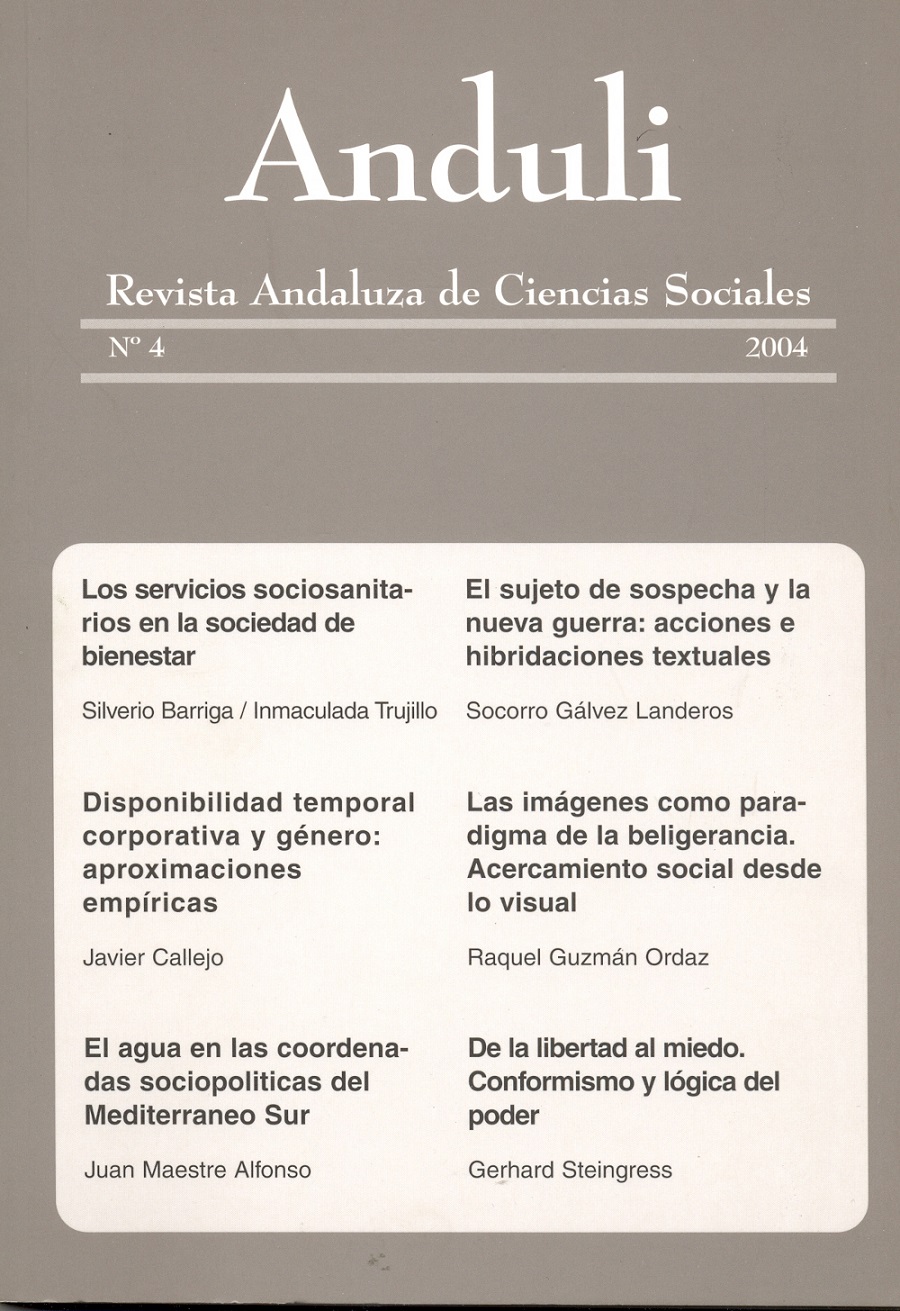
FROM FREEDOM TO FEAR. CONFORMISM AND LOGIC OF POWER
Keywords:
hegemonist discourse, the perspective of contemporary sociology, the coincidence of ideologyAbstract
The hegemonist discourse imposed by the ruling political class of the United States since September 2001 is guided by a vision which defines the objects, methods and reasons of its political behavior on a global scale in accordance with two strategic aims: first, to guarantee its economic, political and military supremacy, and, second, to justify it and its consequences with the help of an aggressive religious fundamentalism merged with the declarations of political principles. Based on the works of John Dewey, Erich Fromm, David Riesman, Herbert Marcuse and others, and from the perspective of contemporary sociology, such as that of Anthony Giddens, Ulrich Beck, Richard Sennett, Christopher Lasch etc., this article analyses the coincidence of this ideology defended by US–ultraconservatives with the strategic interests of globalized capitalism. It emphasizes the peculiar function of the manipulation of public opinion and the intentional production of fear as instruments for the purpose of submitting public consciousness to the dominant interests, generating a generalized and diffuse psychological disposition towards a diminution of the ego and towards conformity with the ruling power–elites, and producing distrust in democracy, characteristics of the authoritarian personality. It is an attempt to analyze the actual trends of destruction of the “social character” in “postmodern” societies and the upcoming of a new kind of irrationalism.
Downloads
References
ADORNO, Theodor W. (2003), Ensayos sobre la propaganda fascista. Psicoanálisis del antisemitismo, Barcelona: Voces y Culturas.
BARBER, Benjamin (2004), El imperio del miedo. Guerra, terrorismo y democracia, Barcelona: Paidós.
BAUDRILLARD, Jean (1984), Las estrategias fatales, Barcelona: Anagrama [Les stratégies fatales, Paris: Editions Grasset & Fasquelle, 1983].
BINSWANGER, Harry (2002), “America vs. death–warship: the moral meaning of the coming war”, en Media Link. The Ayn Rand Institute, www.aynrand.org/media link/ lifeordeath.html (consulta: 29/05/03); también: http://www.harryroolaart.com/index.php?module=article&view=44&MMN_position=73:13 (“printable version”).
BRZEZINSKI, Zbigniew (1998), El gran tablero mundial. La supremacía estadounidense y sus imperativos geoestratégicos, Barcelona: Paidós [Basic Books, 1997].
COLOMER, Josep M. (2003), “Un imperio sin imperialistas”, en El País, 9 de julio de 2003, p. 13.
DEWEY, John (1940), Freedom and Culture, London: Allen & Unwin. – (2003), Viejo y nuevo individualismo, introd. de Ramón del Castillo, Barcelona: Paidós.
ELIAS, Norbert (1976), Über den Prozess der Zivilisation. Soziogenetische und psychogenetische Untersuchungen, 2 tomos, Frankfurt/Main: Suhrkamp. [Ed. esp.: El proceso de la civilización, Madrid: FCE, 1987].
EL PAÍS, lunes 23 de junio de 2003, pág. 31: “Más de 1.55 universidades de EE UU imponen códigos de conducta en los campus”.
ELORZA, Antonio (2003), “La guerra de Irak y el Nuevo Siglo Americano”, en Claves de la Razón Práctica, nº 113, junio, pp. 10–17.
FANON, Frantz, (1999), Los condenados de la tierra, prólogo J.–P. Sarte, Txalaparta Argitaletxea [orig.: Les damnés de la terre, 1961].
FITOUSSI, Jean–Paul (2004), La democracía y el mercado, Barcelona: Paidós.
FROMM, Erich (1966 [1942]), The Fear of Freedom, London: Routledge & Keagan; (1985), El miedo a la libertad, Barcelona: Planeta Agostini. – (1984), On Disobedience and Other Essays, San Francisco: Harper [1981].
FUKUYAMA, Francis (1992), The End of History and the Last Man, Washington. [Ed. esp.: El fin de la Historia y el último hombre, Barcelona: Planeta].
GARMONG, Robert (2003), “Liberty, not democracy, in Iraq”, en Media Link. The Ayn Rand Institute, may 8, [www.aynrand.org/medialink/libertynot democracyiniraq.shtml (consulta: 29/05/03)].
GIDDENS, Anthony (2000), Un mundo desbocado. Los efectos de la globalización en nuestras vidas, Madrid: Santillana (Taurus).
GINER, Salvador (2003), Carisma y razón. La estructura moral de la sociedad moderna, Madrid: Alianza.
GRAMSCI, Antonio (1947ss.), Opere di Antonio Gramsci, Torino: Einaudi.
– (1975), Marxismo e letteratura, Roma: Einaudi.
GRAY, John (2000 [1998]), Falso amanecer. Los engaños del capitalismo global, Barcelona: Paidós.
HABERMAS, Jürgen y DERRIDA, Jacques (2003), “Unsere Erneuerung. Nach dem Krieg: Die Wiedergeburt Europas”, en Frankfurter Allgemeine Zeitung, sábado, 31 de mayo 2003, nº 125, págs. 33–34 [trad. esp.: “Europa: en defensa de una política exterior común”, en El País, miércoles 4 de junio de 2003, pp. 10–11].
HEISBOURG, François (2002), Hiperterrorismo. La nueva guerra, Madrid: Espasa. HORKHEIMER, Max (ed.) (1936), Studien über Autorität und Familie, Paris: Felix Alcan.
HORKHEIMER, Max y ADORNO, Theodor W. (1997), Dialéctica de la Ilustración, Fragmentos filosóficos, Madrid: Trotta (2ª ed.) [Die Dialektik der Aufklärung. Philosophische Fragmente, Amsterdam: Querido, 1947; Frankfurt am Main: Fischer, 1969].
HUNTINGTON, Samuel P. (1993), “The Clash of Civilizations”, Foreign Affairs, 72 (3): 22– 49. – (1997), The Clash of Civilizations. Remaking of World Order, New York: Touchstone.
KAGAN, R. (2003), Poder y debilidad. Europa y Estados Unidos en el nuevo orden mundial, Madrid: Santillana Ediciones Generales (Taurus) [Of Paradise and Power. America and Europe in the New World Order].
KANT, Imanuel (1993), “Respuesta a la pregunta: ¿Qué es la Ilustración?, en: ERHARD, J.B. et al., ¿Qué es la Ilustración?, Estudio preliminar de Agapito Maestre. Trad. de Agapito Maestre y José Romagosa, Madrid: Tecnos (3ª ed.), pp. 17–29.
KARDINER, Abram (1939), The Individual and His Society. The Psychodynamics of Primitive Social Organization, New York. – et. al. (1945), The Psychological Frontiers of Society, New York.
KERTÉSZ, Imre (2003), Yo, otro. Crónica del cambio, Madrid: El Acantilado.
LASCH, Christopher (1999), La cultura del narcisismo, Barcelona: Andrés Bello
LENIN, Wladimir Iljitsch (1960), “Der Imperialismus als höchstes Stadium des Kapitalismus”, en: Lenin Werke, tomo 22.
LUHMANN, Niklas (1971), Soziologische Aufklärung. Aufsätze zur Theorie sozialer Systeme, 2ª ed., Opladen: Westdeutscher Verlag.
LUKÀCS, György (1962, 1973), Die Zerstörung der Vernunft. Irrationalismus zwischen den Revolutionen, 3 tomos, Darmstadt y Neuwied: Luchterhand. [Ed. orig.: Budapest: Akadémiai Kiadó, 1954].
MARCUSE, Herbert (1958), Soviet Marxism. A Crítical Analysis, New York: Columbia University Press.
– (1985), El hombre unidimensional, Barcelona: Planeta–Agostini [The one–dimensional man. Studies in the Ideology of Advanced Industrial Society, Boston: Beacon Press, 1964].
MAYER, J. P. (1972), Alexis de Tocqueville. Analytiker des Massenzeitalters, München: Beck (3ª ed.).
PRIGOGINE, Ilya (1998), El nacimiento del tiempo, Barcelona: Tusquets (3ª ed.). Project for the New American Century. Statement of Principles (PNAC), June 3, 1997, [www.new americancentury.org/statementofprinciples.htm, (consulta: 29/05/03)].
RIESMAN, David (1967 [1958]), Die einsame Masse. Eine Untersuchung der Wandlungen des amerikansichen Charakters. Mit einer Einführung von Helmut Schelsky, Rowohlt [orig.: The Lonely Crowd. A Study of the Changing American Character, Yale University Press, 1950)
ROTH, Gerhard (2003), Fühlen, Denken, Handeln. Die neurobiologischen Grundlagen des menschlichen Verhaltens, Frankfurt: Suhrkamn.
SAID, Edward. W. (2003), “El humanismo como resistencia”, en El País, 23 de agosto de 2003, “Babelia”, p. 8.
SENNETT, R. (2000), La corrosión del carácter. Las consequencias personales del trabajo en el nuevo capitalismo, Madrid: Anagrama.
SCHUMPETER, J. A. (1942), Capitalism, Socialism and Democracy, New York: Harper & Brothers. STIGLITZ, Joseph E. (2003), El malestar en la globalización, trad. De Carlos Rodríguez Braun, Madrid: Santillana Ediciones Generales, (tit. orig.: Globalization and its Discontents, 2002).
THE AYN RAND INSTITUTE (2003), “America at War”, en Media Link. The Ayn Rand Institute, [www.aynrand.org/medialink/actofwar.html (consulta: 29/05/03)].
THE ECONOMIST, 19 de julio 2003, p. 30: “Fear itself”. TRACINSKI, Robert W. (2003), “The road to victory goes through Tehran”, en Media Link. The Ayn Rand Institute, may 14, www.aynrand.org/medialink/roadtovictory.shtml (consulta: 29/05/03).
TRIFONOW, Juri (1975), Ungeduld, Berlin: Volk und Welt [ed. rusa: HETEPIIHNE, Moscú, 1973]. VEBLEN, Thorstein (2004 [1899]), Teoría de la clase ociosa, Madrid: Alianza
Downloads
Published
How to Cite
Issue
Section
License
The printed and electronic editions of this Journal are published by Editorial Universidad de Sevilla, and it is necessary to cite the source in any partial or total reproduction.
Unless otherwise indicated, all contents of the electronic edition are distributed under a "Creative Commons Attribution-NonCommercial-NoDerivative 4.0 International" license. You can consult from here the informative version and the legal text of the license. This circumstance must be expressly stated in this way when necessary.
The authors who publish in this journal accept the following conditions:
1. The authors retain the copyright and assign to the journal the right of first publication, with the work registered with the license of attribution of Creative Commons, which allows third parties to use what has been published as long as they mention the authorship of the work and the first publication in this journal.
2. Authors may make other independent and additional contractual agreements for non-exclusive distribution of the version of the article published in this journal (e.g., inclusion in an institutional repository or publication in a book) as long as they clearly indicate that the work was first published in this journal.
3. Authors are allowed and encouraged to publish their work on the Internet (e.g., on institutional or personal pages) before and during the review and publication process, as this may lead to productive exchanges and greater and faster dissemination of the published work (see The Effect of Open Access).