
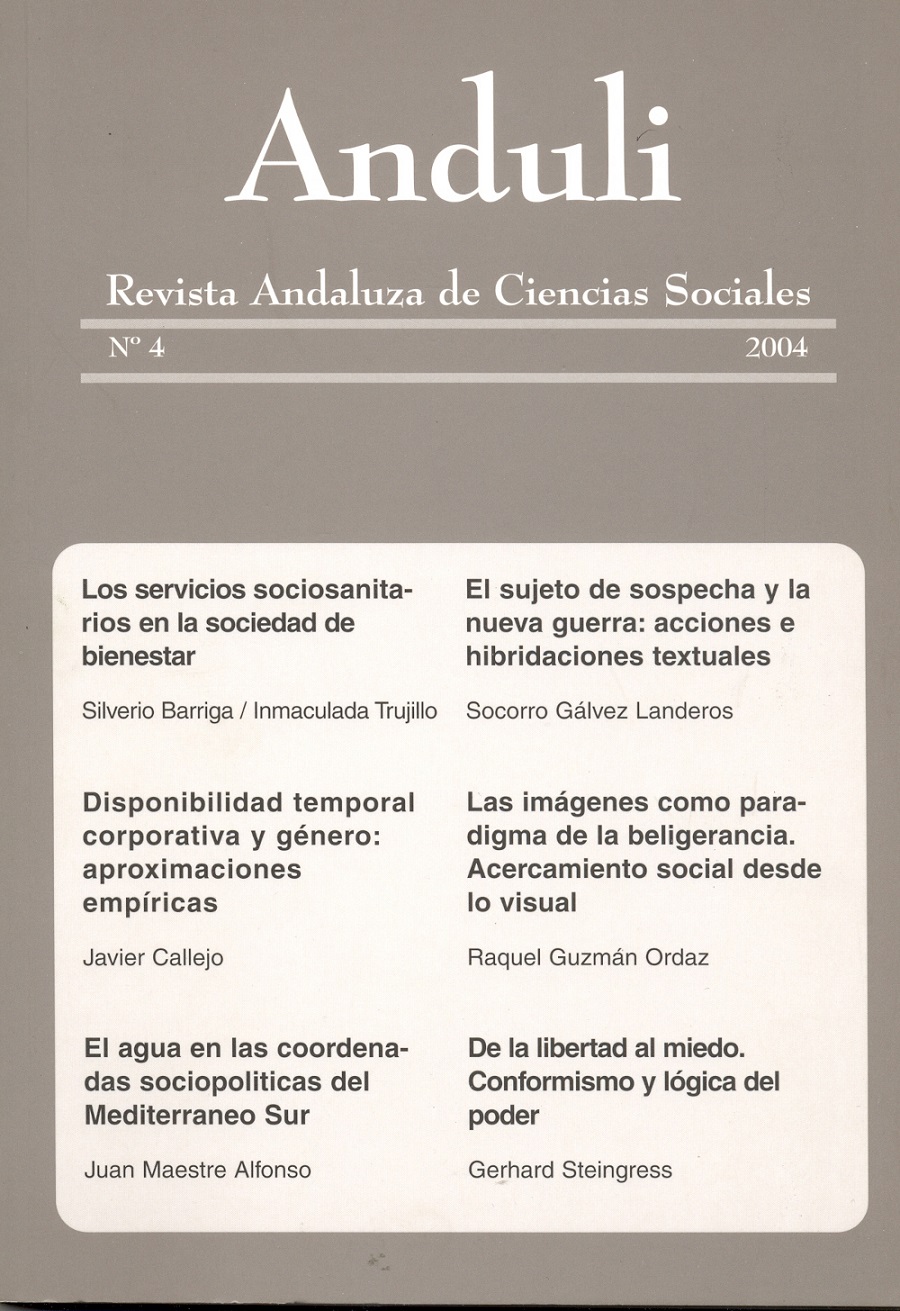
THE SUBJECT OF SUSPECT AND THE NEW WAR: ACTIONS AND HYBRIDIZATIONS TEXTUALS
Keywords:
the New Wars, the other subject, the subject of suspicionAbstract
Globalization supposes an incessant process of international involvement where individualization is one of its characteristics imposed with the help of the de–/ revinculation of the subjects under the conditions of reflexive modernization. Mary Kaldor considers that the New Wars have to be analyzed in this sense. The present article investigates on the other subject, immanent to wars, the subject of suspicion, interpellated by imperialism that serves him from technology in order to connect it with individualization and its ethic possibilities.
Downloads
References
AZNÁREZ, Juan Jesús (2003), “Soldados hispanos contra Sadam Hussein”, El País (Internacional), 29 de marzo, pág.12 .
BATAILLE, Georges (1975), Teoría de la Religión, Madrid: Taurus.
BAUDRILLARD, Jean (1996), El crimen perfecto, Barcelona: Anagrama.
BECK, Ulrich (1998), ¿Qué es la globalización? Falacias del globalismo, respuestas a la globalización, Barcelona: Paidós.
BECK, U. GIDDENS, A. y LASH, S. (1994), Modernización reflexiva. Política, tradición y estética en el Orden social moderno, Madrid: Alianza Universidad.
BOBBITT, Philip (2002), The shields of Achilles: war, peace and the course of history, Nueva York: Knopf, Random House.
BUTLER, Judith (2001), Mecanismos psíquicos del poder. Teorías sobre la sujeción, Madrid: Ediciones Cátedra.
DERRIDA, Jaques “ (2003), ¿Hay estados canallas? La razón del más fuerte”, Le Monde Diplomatique, edición española, nº 87, pág. 3.
DURAS, Marguerite (1999), El dolor, Barcelona: Alba Editorial, Trayectos.
GIL CALVO, Enrique (2003), “El modernismo reaccionario y el espíritu de Westfalia”, El País, 26 de febrero, pág.12.
HABERMAS, Jürgen (2000), La constelación posnacional. Ensayos políticos, Barcelona: Paidós, págs. 59–80, 169–198. – (2003), “¿Qué significa el derribo del monumento?”, El País (Internacional), 20 de mayo, págs. 7–8.
IGNATIEFF, Michael (1998), The warrior’s honor: Ethnic war and the modern consience, Nueva York: Owl Books.
JOHNSON, Chalmers (2000), Blowback: the cost and consequences of American empire, Nueva York: Owl Books.
KALDOR, Mary (2001), Las nuevas guerras. Violencia organizada en la era global. Barcelona: Tusquets.
KANT, Immanuel (1993), “Respuesta a la pregunta: ¿Qué es la ilustración?”, en Erhard, J. B. et. al., ¿Qué es Ilustración?, Madrid: Tecnos, 3ª ed., págs.17–29.
MAILLARD, Jean (2003), “Recolonización del mundo. Los aliados en primera fila para proteger el imperio”, Le Monde diplomatique, edición española, nº 87, pág. 6.
MILBANK, Dana y SLEVIN, Peter (2003), “President details vision of Iraq”, The Washington Post Digital, 27 de febrero, pág. A 01 [www.washingtonpost.com].
ORTEGA, Andrés (2002), “El diseño del nuevo imperio”, El País (Domingo),1 de diciembre, págs.1–3.
PEÑALVER, Patricio (2002), “Contextos de Imperio”, Revista de Occidente, nº 259 págs. 63–89. RAMOS, Carlos (2003), “El Pentágono monta un rally”, El País, 28 de febrero, pág. 72.
SERRANO, Agustín (2002), “La concepción del Imperialismo en la obra de Hanna Arendt”, Revista de Occidente, nº 259, págs. 91–113.
TODD, Emmanuel (2003) After the Empire: The breakdown of the American Order, Nueva York: Columbia University Press.
TOWNSEND, Rosa (2002), “Todo el planeta bajo sospecha. El proyecto de espionaje mundial de EE UU arranca entre dudas sobre su capacidad operativa y sus límites legales”, El País (Internacional), 1 de diciembre, pág. 6.
VAN BUREEN, Jelle (2003), “Los tentáculos del acuerdo Schengen”, Le Monde Diplomatique, edición española, nº 89, pág. 3.
VAN HAECHT, Anne (1999), La escuela va a examen, Eds. Biblos y Miño y Dávila VICENT, Manuel (1986), Balada de Caín, Barcelona: Ediciones Destino.
YÁRNOZ, Carlos (2003), “La Eurocámara exige que las aerolíneas europeas no den datos de pasajeros a EE UU”, El País (Internacional), 14 de marzo, pág. 12.
Downloads
Published
How to Cite
Issue
Section
License
The printed and electronic editions of this Journal are published by Editorial Universidad de Sevilla, and it is necessary to cite the source in any partial or total reproduction.
Unless otherwise indicated, all contents of the electronic edition are distributed under a "Creative Commons Attribution-NonCommercial-NoDerivative 4.0 International" license. You can consult from here the informative version and the legal text of the license. This circumstance must be expressly stated in this way when necessary.
The authors who publish in this journal accept the following conditions:
1. The authors retain the copyright and assign to the journal the right of first publication, with the work registered with the license of attribution of Creative Commons, which allows third parties to use what has been published as long as they mention the authorship of the work and the first publication in this journal.
2. Authors may make other independent and additional contractual agreements for non-exclusive distribution of the version of the article published in this journal (e.g., inclusion in an institutional repository or publication in a book) as long as they clearly indicate that the work was first published in this journal.
3. Authors are allowed and encouraged to publish their work on the Internet (e.g., on institutional or personal pages) before and during the review and publication process, as this may lead to productive exchanges and greater and faster dissemination of the published work (see The Effect of Open Access).