
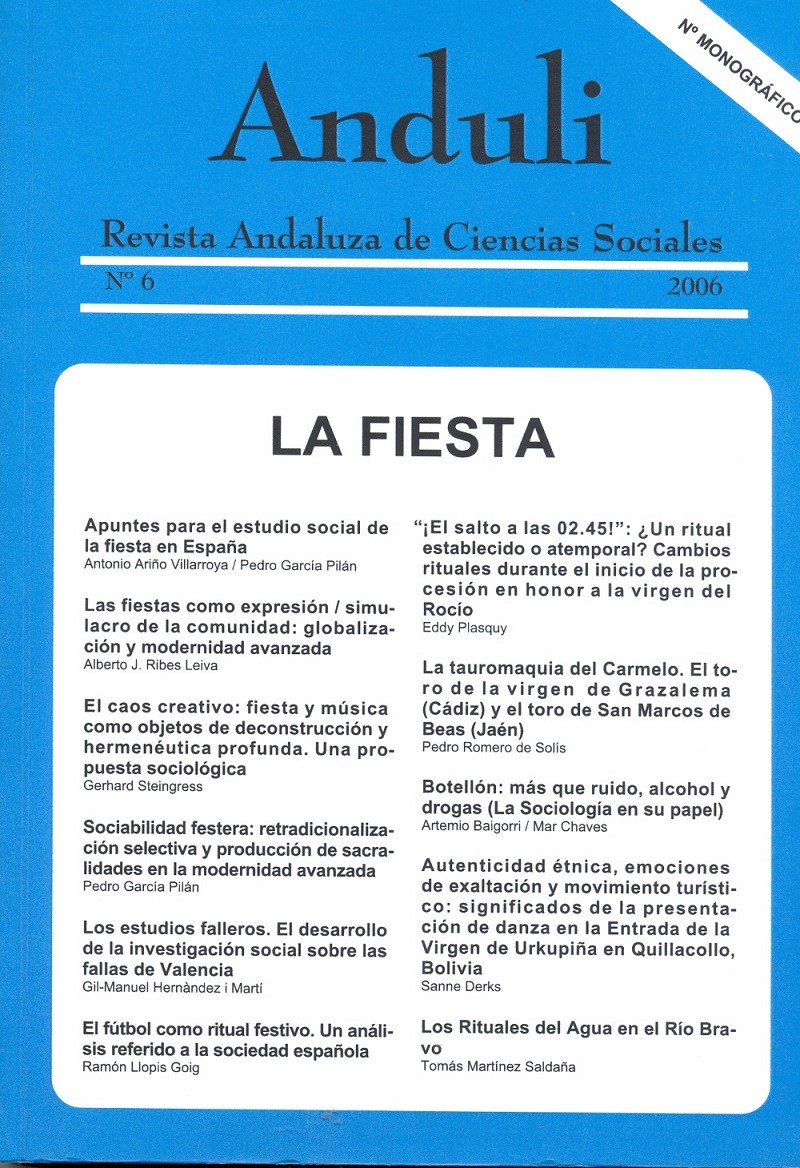
"THE JUMPING AT 02.45!": AN ESTABLISHED OR ATEMPORAL RITUAL? RITUAL CHANGES DURING THE START OF HONOR PROCESSING THE VIRGIN OF THE ROCK
Keywords:
pilgrimage, locality, ritual transformationsAbstract
The culminating point of the yearly pilgrimage in honor of the Virgin Mary in the Andalusian hamlet of El Rocío takes place when the local men jump over the altar fence and violently carry the statue out of the church, the so-called ‘salto a la reja’. The paper explores the transformations that underwent this act during the last fifty years. It argues that in this process not only a violently and authority threatening revolt was canalized into a harmless ritual, but that at the same time this ‘novel’ ritual became to represent a new-found ‘timeless’ authenticity within the pilgrimage. As such, the local men, fiercely defending their ‘local’ rights, slowly developed into a symbol in themselves, trapped in an expanding pilgrimage wherein experiencing ‘locality’ might become more important than the devotion towards ‘their’ Virgin.
Downloads
References
Alvares Gastón, R. (1975), El Rocío a examen, Sevilla: Editorial Católica Española.
Alvares Gastón, R. (1981), Las Raíces del Rocío, Huelva. Cantero, P. A. (2002), Tras el Rocío, Almonte:Cuadernos de Almonte.
Comelles, J. M. (1984), "Los caminos del Rocío" en: Rodríguez Becerra, S. (coord.), Antropología cultural de Andalucía, Sevilla: Consejería de Cultura de la Junta de Andalucía, págs. 425-445.
Comelles, J. M. (1991), "Los caminos del Rocío" en: Prat, J. et al. (coords.), Antropología de los Pueblos de España, Madrid: Taurus ediciones, págs. 755-770.
Comelles, J. M. (1995), "Rocíos" en Demófilo, 17, Sevilla: Fundación Machado, págs. 13- 39. Diaz de la Serna, Á. et al. (1998), El Rocío de siempre (2ª ed.), Cordoba: Caja Sur.
Gluckman, M. (1954), Rituals of Rebellion in South-East Africa, Cambridge, Cambridge University Press.
Gonzáles Faraco, J.C. y Murphy, M.D. (2002) "El Rocío: la evolución de una aldea sagrada" en: Murphy, Michael D. y Gonzáles Faraco, J. C. (coords.), El Rocío: Análisis culturales e históricos, Huelva: Diputación de Huelva, págs. 55-91.
Jimeno Salvatierra, P. (2004), Rituales de identidad revitalizados (2ª ed.), Madrid: UAM. Millán Pérez, A. (1995), Memorias de la Construcción del Nuevo Santuario del Rocío 1963-1969, Almonte: Antonio Millán Pérez.
Moreno Navarro, I. (1982), "Confradias andaluzas y fiestas: aspectos socioantropologicos" en Tiempo de Fiesta. Ensayos Antropologicos sobre las fiestas en España, Madrid, Ed. Tres, Catorce, Diecisiete, págs. 71-93.
Moreno Navarro, I. (1990), "Niveles de significación de los iconos religiosos y rituales de reproducción de identidad en Andalucía" en La fiesta, la ceremonia, el rito. Coloquio, Granada, Universidad de Granada y Casa de Velasquez (Cordoba), págs. 91-103.
Moreno Navarro, I. (1993), "El Roció: de Romería de las Marismas a fiesta de identidad andaluza" en Fraguas, A. et al. (coords.), Romerías y Peregrinacions. Simposio de Antropoloxia X, Santiago de Compostela: Consello de Cultura Galega, págs. 121- 141.
Murphy, Michael D. (1993), "The Politics of Tumult in Andalusian Ritual" en PoLAR: Political and Legal Anthropology Review, 16 (2), págs. 75-84.
Murphy, Michael D. y Gonzáles Faraco, J. C. (1996), Masificación ritual, identidad local y toponimia en El Rocío. Demófilo, 20, Sevilla: Fundación Machado, págs. 101-120.
Murphy, Michael D. y Gonzáles Faraco, J. C. (coords.) (2002), El Rocío: Análisis culturales e históricos, Huelva: Diputación de Huelva.
Rodríguez Becerra, S. (1989), "La romería del Rocío, fiesta de Andalucía" en El Folklore Andaluz. 3, págs. 147-152.
Rodríguez Becerra, S. (2000), Religión y Fiesta. Antropología de las Creencias y Rituales en Andalucía, Sevilla: Signatura Demos.
Schröder, S. (2004), "Rituals of Rebellion - Rebellion as Ritual: A theory Reconsidered" en Kreinath, J. , Hartung, C. y Deschner, A., The Dynamics of Changing Rituals, Toronto Studies in Religion 29, New York, Peter Lang.
Zapata García, M. (1991), El Rocío. Estudio psicoanalítico de la devoción mariana en Andalucía, Sevilla: J. Rodríguez Castillejo.
Downloads
Published
How to Cite
Issue
Section
License
The printed and electronic editions of this Journal are published by Editorial Universidad de Sevilla, and it is necessary to cite the source in any partial or total reproduction.
Unless otherwise indicated, all contents of the electronic edition are distributed under a "Creative Commons Attribution-NonCommercial-NoDerivative 4.0 International" license. You can consult from here the informative version and the legal text of the license. This circumstance must be expressly stated in this way when necessary.
The authors who publish in this journal accept the following conditions:
1. The authors retain the copyright and assign to the journal the right of first publication, with the work registered with the license of attribution of Creative Commons, which allows third parties to use what has been published as long as they mention the authorship of the work and the first publication in this journal.
2. Authors may make other independent and additional contractual agreements for non-exclusive distribution of the version of the article published in this journal (e.g., inclusion in an institutional repository or publication in a book) as long as they clearly indicate that the work was first published in this journal.
3. Authors are allowed and encouraged to publish their work on the Internet (e.g., on institutional or personal pages) before and during the review and publication process, as this may lead to productive exchanges and greater and faster dissemination of the published work (see The Effect of Open Access).