
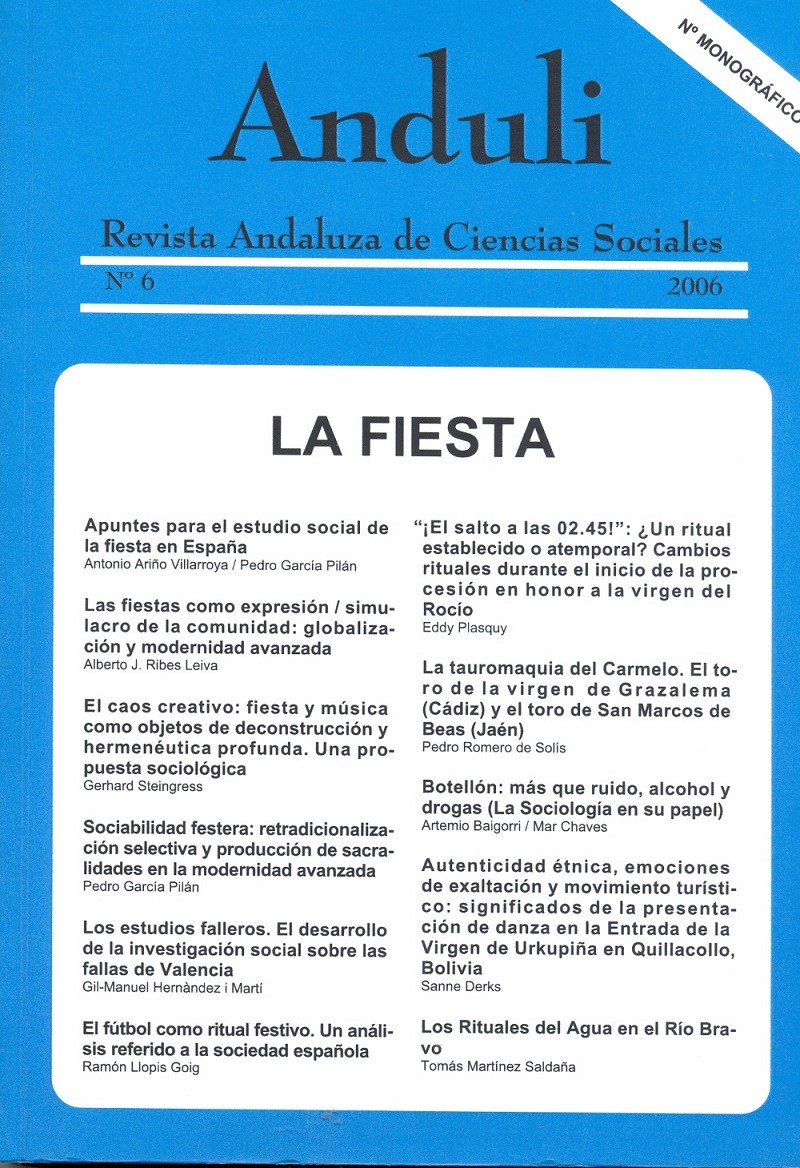
LAS FIESTAS COMO EXPRESIÓN / SIMULACRO DE LA COMUNIDAD: GLOBALIZACIÓN Y MODERNIDAD AVANZADA
Palabras clave:
“Efervescencia colectiva”, glocalización, globalización, sociología durkheimiana, comunidadResumen
En este artículo consideramos las fiestas como un tipo de “efervescencia colectiva” de la que hablaba Durkheim. También exploramos el concepto clásico de comunidad, e intentamos explicar que está pasando hoy en día con esas comunidades. Finalmente, analizamos las fiestas locales y las fiestas globales como los dos tipos principales de expresión / simulacro de las comunidades actuales.
Descargas
Citas
Alexander, J.C., (2000), Sociología cultural: formas de clasificación en las sociedades complejas, Anthropos, Barcelona.
Álvarez Junco, J., (1996), “Hobsbawn sobre nacionalismo”, en Historia Social, Nº 25. (2001), Mater Dolorosa: La idea de España en el siglo XIX, Taurus, Madrid.
Anderson, B., (1993), Comunidades Imaginarias, Fondo de Cultura Económica, Madrid.
Bauman, Z., (2003), Modernidad líquida, F.C.E., Buenos Aires. (2003b), Comunidad: en busca de seguridad en un mundo hostil, Siglo XXI, Madrid.
Collins, R., (2004), Interaction ritual chains, Princeton University Press, Princeton.
Durkheim, E., (1972), “A review of Ferdinand Tönnies’s Gemeinschaft und Gesellschaft”, en The American journal of sociology, Vol. 77, 6, mayo. (
, La división del trabajo social, 2 vols., Planeta-Agostini, Barcelona.
(2000), Sociología y filosofía, Miño y Dávila, Madrid.
(2003), Las formas elementales de la vida religiosa, Alianza Editorial, Madrid.
Giner, S., (2004), Teoría sociológica clásica, Ariel, Barcelona. Hobsbawm, E., (2000), Naciones y nacionalismos, Biblioteca de Bolsillo, Madrid.
Marx, K., y Engels, F., (1998), Manifiesto comunista, Editorial Debate, Madrid.
Ribes Leiva, A.J., (2006), “Tras las dos crisis de la modernidad del siglo XX: una visión crítica de la sociedad de la información y del conocimiento”, en Marcuello, Ch. y Fandos, J. L. (eds.), Cambio cultural, problemas sociales y sociedad del conocimiento: aproximaciones sociológicas para una sociedad mundial, Prensas de la Universidad de Zaragoza, Zaragoza.
(2007), Paisajes del siglo XX: sociología y literatura en Francisco Ayala, Biblioteca Nueva, Madrid.
Ricoeur, P., (2004), Tiempo y narración: configuración del tiempo en el relato histórico, Siglo XXI, México.
Robertson, R., (1995), “Glocalization: Time-Space and Homogeneity-Heterogeneity”, en Featherstone, M., Lash, S. y Robertson, R. (eds.), Global modernities, Sage, Londres.
Tönnies, F., (1972), “A review of Émile Durkheim’s De la division du travail social”, en The American journal of sociology, Vol. 77, 6, mayo. (1979), Comunidad y asociación, Editorial Península, Barcelona.
Weber, M., (1993), Economía y Sociedad, Fondo de Cultura Económica., Madrid.
Descargas
Publicado
Cómo citar
Número
Sección
Licencia
Las ediciones impresa y electrónica de esta Revista son editadas por el Editorial Universidad de Sevilla, siendo necesario citar la procedencia en cualquier reproducción parcial o total.
Salvo indicación contraria, todos los contenidos de la edición electrónica se distribuyen bajo una licencia de uso y distribución “Creative Commons Atribución-NoComercial-SinDerivar 4.0 Internacional”  Puede consultar desde aquí la versión informativa y el texto legal de la licencia. Esta circunstancia ha de hacerse constar expresamente de esta forma cuando sea necesario.
Los autores/as que publiquen en esta revista aceptan las siguientes condiciones:
- Los autores/as conservan los derechos de autor y ceden a la revista el derecho de la primera publicación, con el trabajo registrado con la licencia de atribución de Creative Commons, que permite a terceros utilizar lo publicado siempre que mencionen la autoría del trabajo y a la primera publicación en esta revista.
- Los autores/as pueden realizar otros acuerdos contractuales independientes y adicionales para la distribución no exclusiva de la versión del artículo publicado en esta revista (p. ej., incluirlo en un repositorio institucional o publicarlo en un libro) siempre que indiquen claramente que el trabajo se publicó por primera vez en esta revista.
- Se permite y recomienda a los autores/as a publicar su trabajo en Internet (por ejemplo en páginas institucionales o personales) antes y durante el proceso de revisión y publicación, ya que puede conducir a intercambios productivos y a una mayor y más rápida difusión del trabajo publicado (vea The Effect of Open Access).