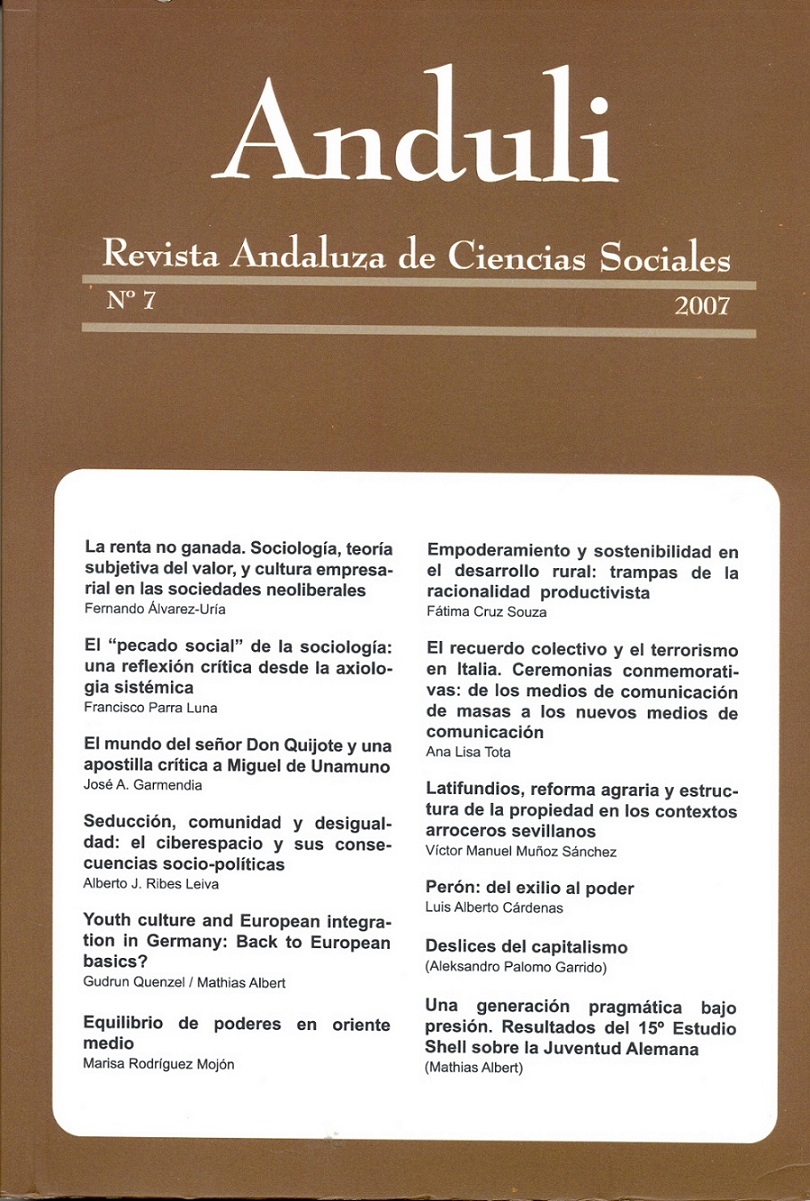
EQUILIBRIUM OF POWERS IN MIDDLE EAST
Keywords:
International Relations, Middle East, World LeadershipAbstract
Some of the stronger State actors in the Middle East are struggling in a competition for hegemony that includes the control of the wealth of the zone, as well as a desire to increase both their prestige among the public opinion of their own countries and their leadership within the international scenario. To attain this goal, they do not hesitate to reinforce the problems of the zone, and even use the suffering of the Palestinian people, in their own benefit. Among other things, some of those countries have decided to give themselves nuclear armament, which could result in a useless, but very dangerous, nuclearization of the whole region.
Downloads
References
AMIRA, H. (2007), “¿Se evitará la Cuarta Guerra del Golfo?”, Política Exterior, 117 (mayojunio), 1-9.
BURNS, N. (2007), A Conversation on Iran and US National Security, Washington D.C.: The Brooking Institution.
RODRIGUEZ, M. (2008), “ONU: Su Función y Posibilidades en el Restablecimiento de los Equilibrios Regionales”, en El Líbano y la Crisis de Oriente Medio. Perspectivas de Evolución, Monografías del CESEDEN, 102, 59-79.
SCHORÍ, P. (2007), “La Doble Moral Europea hacia el Mundo Arabe”, El País, jueves, 17 de Mayo.
SERRA, N. (2007), “Introducción” a Irán, Potencia Emergente en Oriente Medio. Implicaciones en la Estabilidad del Mediterráneo, Cuadernos de Estrategia, 137, Madrid: Publicaciones del Ministerio de Defensa, 11-17.
STAMPA, L. (2007), “La Nuclearización de Irán y su Repercusión como Actor Regional”, en Irán, Potencia Emergente en Oriente Medio. Implicaciones para la Estabilidad en el Mediterráneo. Cuadernos de Estrategia, 137, Madrid: Publicaciones del Ministerio de Defensa, 99-130.
THE ECONOMIST (2006), “Ending Will be Harder”, special report: Crisis in the Middle East, 11 de Julio, 27-30. ZARZUELA, A. (2006), “La Hora de la FINUL”, Cambio 16, 11 de Septiembre
Downloads
Published
How to Cite
Issue
Section
License
The printed and electronic editions of this Journal are published by Editorial Universidad de Sevilla, and it is necessary to cite the source in any partial or total reproduction.
Unless otherwise indicated, all contents of the electronic edition are distributed under a "Creative Commons Attribution-NonCommercial-NoDerivative 4.0 International" license. You can consult from here the informative version and the legal text of the license. This circumstance must be expressly stated in this way when necessary.
The authors who publish in this journal accept the following conditions:
1. The authors retain the copyright and assign to the journal the right of first publication, with the work registered with the license of attribution of Creative Commons, which allows third parties to use what has been published as long as they mention the authorship of the work and the first publication in this journal.
2. Authors may make other independent and additional contractual agreements for non-exclusive distribution of the version of the article published in this journal (e.g., inclusion in an institutional repository or publication in a book) as long as they clearly indicate that the work was first published in this journal.
3. Authors are allowed and encouraged to publish their work on the Internet (e.g., on institutional or personal pages) before and during the review and publication process, as this may lead to productive exchanges and greater and faster dissemination of the published work (see The Effect of Open Access).