
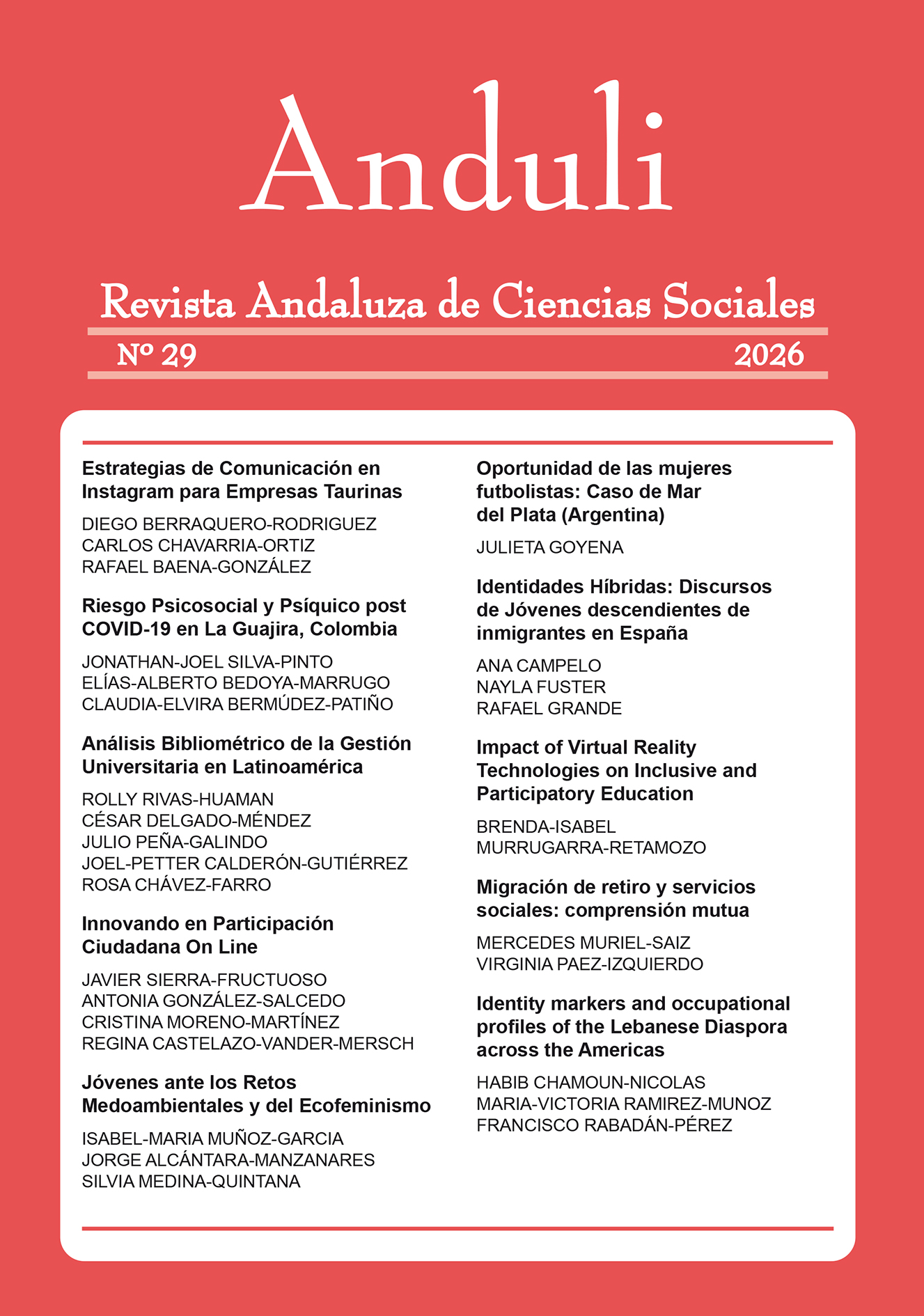
Identity markers and occupational profiles of the Lebanese Diaspora across the Americas
DOI:
https://doi.org/10.12795/anduli.2026.i29.10Palabras clave:
Herencia cultural, Autoidentificación, transmisión intergeneracional, vínculos familiares, pertenencia transnacional, estructura ocupacional, México, Argentina, Ecuador, EE.UU.Resumen
Understanding how cultural identity and inherited values shape career trajectories is a key issue in diaspora studies. This study focuses on the case of the Lebanese diaspora in the Americas, its identity markers, and its narratives of identity pride. For that purpose, an online survey was conducted in 2021 with 507 individuals of Lebanese descent living in the Americas, mainly in México, followed by Argentina, Ecuador, Colombia, and other countries. Analysis of results shows predominant self-identification as Lebanese, as well as a very common dual pattern of pride combining their Lebanese heritage with the American country of birth or residence. Lebanese language proficiency is limited, and feelings of disconnection from their Lebanese local community is most common among those who do not understand the language. Regarding narratives of identity pride, the most frequent values highlighted are roots, culture, and family on one side, but also relational and prosocial values, which often could be associated with jobs chosen by the interviewees in professions related to business and commerce.
Descargas
Citas
Agresti, A. (2013). Categorical Data Analysis (3rd ed.). Wiley.
Ajrouch, K. J., & Kusow, A. M. (2007). Racial and religious contexts: Situational identities among Lebanese and Somali Muslim immigrants. Ethnic and Racial Studies, 30(1), 72–94. https://doi.org/10.1080/01419870601006553
Appadurai, A. (1999). Globalization and the research imagination. International Social Science Journal, 51(160), 229–238. https://doi.org/10.1111/1468-2451.00191
Bahajin, S. (2008). El modelo latinoamericano en la integración de los inmigrantes árabes. Ra Ximhai: Revista Científica de Sociedad, Cultura y Desarrollo Sostenible, 4(3), 737–773.
Balloffet, L. P. (2019). Arabic-Speaking Migrants in 19th- and 20th-Century Latin America. In Oxford Research Encyclopedia of Latin American History. Oxford University Press. https://doi.org/10.1093/acrefore/9780199366439.013.102
Bérodot, S., & Pozzo, M. I. (2012). Historia de la inmigración sirio-libanesa en Argentina desde la perspectiva compleja del métissage. Aportes para una educación intercultural. Revista IRICE, 24(24), 47–56. https://doi.org/10.35305/revistairice.v24i24.470
Bhabha, H. K. (2012). The Location of Culture (2nd ed.). Routledge. https://doi.org/10.4324/9780203820551
Eid, Z., & Sallabank, J. (2021). Language attitudes and language practices of the Lebanese community in the UK. International Journal of the Sociology of Language, 2021(269), 179–202. https://doi.org/10.1515/ijsl-2020-0008
Faist, T. (2010). Towards Transnational Studies: World Theories, Transnationalisation and Changing Institutions. Journal of Ethnic and Migration Studies, 36(10), 1665–1687. https://doi.org/10.1080/1369183X.2010.489365
Hall, S. (2011). Introduction: Who Needs “Identity”? In S. Hall & P. du Gay (Eds.), Questions of Cultural Identity (pp. 1–17). SAGE Publications. https://sk.sagepub.com/books/questions-of-cultural-identity/n1.xml
Hamui-Halabe, L. (1994). Los libaneses en América Latina: Una conversación académica. Revista Mexicana de Ciencias Políticas y Sociales, 39(155), 205–210. https://doi.org/10.22201/fcpys.2448492xe.1994.155.50641
Han, X., Goxe, F., & Freeman, S. (2024). Internationalization through social networks: A systematic review and future research agenda. International Business Review, 33(4), 102292. https://doi.org/10.1016/j.ibusrev.2024.102292
Hannerz, U. (2010). Diversity Is Our Business. American Anthropologist, 112(4), 539–551. https://doi.org/10.1111/j.1548-1433.2010.01274.x
Humphrey, M. (2004). Lebanese Identities: Between Cities, Nations and Trans-Nations. Arab Studies Quarterly, 26(1), 31–50.
Joseph, S. (1999). Intimate Selving in Arab Families: Gender, Self, and Identity. Syracuse University Press.
Joseph, S. (2000). Gender and Citizenship in the Middle East. Syracuse University Press. http://archive.org/details/gendercitizenshi00suad
Joseph, S. (2011). Political Familism in Lebanon. The ANNALS of the American Academy of Political and Social Science, 636(1), 150–163. https://doi.org/10.1177/0002716211398434
Jozami, G. (1995). The Lebanese in the World: A Century of Emigration. Edited by Albert Hourani and Nadim Shehadi. (London: I.B. Tauris for the Centre for Lebanese Studies, 1992. Pp. 57. Illustrations. L45.). The Americas, 51(3), 468–469. https://doi.org/10.2307/1008256
Karam, J. T. (2013). The Lebanese Diaspora at the Tri-Border and the Redrawing of South American Geopolitics, 1950–1992. Mashriq & Mahjar: Journal of Middle East and North African Migration Studies, 1(1). https://muse.jhu.edu/pub/353/article/779803
Karam, J. T. (2021). The Levant in Latin America. In A. Bayat (Ed.), Global Middle East: Into the Twenty-First Century (pp. 253–266). University of California Press. https://doi.org/10.1525/9780520968127-022
Kaufman, A. (2004). Reviving Phoenicia: The Search for Identity in Lebanon. Bloomsbury Academic.
Khater, A. F. (2001). Inventing Home: Emigration, Gender, and the Middle Class in Lebanon, 1870–1920. University of California Press.
Kianpour, P., Triandafyllidou, A., Allen, T., Mazrouei, S., & Shams, M. (2025). Social media narratives, diasporic identity and collective memory: A critical synthesis of the literature. Ethnicities, 25(2), xx–xx. https://doi.org/10.1177/14687968251386072
Klich, I., & Lesser, J. (1996). Introduction: “Turco” Immigrants in Latin America. The Americas, 53(1), 1–14. https://doi.org/10.2307/1007471
Kraidy, M. M. (2006). Hybridity, or the Cultural Logic of Globalization. Temple University Press. https://doi.org/10.26530/oapen_626979
Lefort, B. (2024). Conflicted Identities: Negotiating Belonging among Young People from the Lebanese Diasporas in Montreal. In É. Féron & B. Baser (Eds.), Diasporas and Transportation of Homeland Conflicts: Inter-group Dynamics and Host Country Responses. Routledge. https://doi.org/10.4324/9781003449751-5
Levitt, P. (2009). Roots and Routes: Understanding the Lives of the Second Generation Transnationally. Journal of Ethnic and Migration Studies, 35(7), 1225–1242. https://doi.org/10.1080/13691830903006309
Levitt, P., & Schiller, N. G. (2004). Conceptualizing Simultaneity: A Transnational Social Field Perspective on Society. International Migration Review, 38(3), 1002–1039. https://doi.org/10.1111/j.1747-7379.2004.tb00227.x
Nagel, C. R. (2002). Constructing difference and sameness: The politics of assimilation in London’s Arab communities. Ethnic and Racial Studies, 25(2), 258–287. https://doi.org/10.1080/01419870120109485
Nagel, C. R. (2009). Rethinking Geographies of Assimilation. The Professional Geographer, 61(3), 400–407. https://doi.org/10.1080/00330120902941753
Nichols, A. L., & Edlund, J. (Eds.). (2023). The Cambridge Handbook of Research Methods and Statistics for the Social and Behavioral Sciences: Volume 1: Building a Program of Research. Cambridge University Press.
Pisarevskaya, A., Scholten, P., & Kaşlı, Z. (2022). Classifying the Diversity of Urban Diversities: An Inductive Analysis of European Cities. Journal of International Migration and Integration, 23(2), 655–677. https://doi.org/10.1007/s12134-021-00851-z
Popescu, C., & Pudelko, M. (2024). The impact of cultural identity on cultural and language bridging skills of first and second generation highly qualified migrants. Journal of World Business, 60, 101571. https://doi.org/10.1016/j.jwb.2024.101571
Putnam, R. D. (2000). Bowling Alone: The Collapse and Revival of American Community. Simon and Schuster.
Ramírez Carrillo, L. A. (2018). Identidad persistente y nepotismo étnico: Movilidad social de inmigrantes libaneses en México. Nueva Antropología. Revista de Ciencias Sociales, 31(89), 10–23.
Renzaho, A. M. N., Polonsky, M., Yusuf, A., Ferdous, A., Szafraniec, M., Salami, B., & Green, J. (2023). Migration-related Factors and Settlement Service Literacy: Findings from the Multi-site Migrants’ Settlement Study. Journal of International Migration and Integration, 24(4), 1589–1609. https://doi.org/10.1007/s12134-023-01023-x
Schiller, N. G., Basch, L., & Blanc-Szanton, C. (1992). Transnationalism: A New Analytic Framework for Understanding Migration. Annals of the New York Academy of Sciences, 645(1), 1–24. https://doi.org/10.1111/j.1749-6632.1992.tb33484.x
Tabar, P. (2010). Lebanon: A Country of Emigration and Immigration. Institute for Migration Studies. https://data.infopro.com.lb/file/LebanonaCountryofEmigrationandImmigration2010PaulTabar.pdf
Tuominen, M. (2023). Building social capital in a new home country: A closer look into the predictors of bonding and bridging relationships of migrant populations at different education levels. Migration Studies, 11(4), 598–618. https://doi.org/10.1093/migration/mnad022
Vertovec, S. (2001). Transnationalism and identity. Journal of Ethnic and Migration Studies, 27(4), 573–582. https://doi.org/10.1080/13691830120090386
Vertovec, S. (2004). Migrant Transnationalism and Modes of Transformation. International Migration Review, 38(3), 970–1001. https://doi.org/10.1111/j.1747-7379.2004.tb00226.x
Vlase, I. (2024). Unlocking the Potential of the Decolonial Approach in Migration Studies. Sociology Compass, 18(1), e70004. https://doi.org/10.1111/soc4.70004
Volk, L. (2008). When Memory Repeats Itself: The Politics of Heritage in Post-Civil War Lebanon. International Journal of Middle East Studies, 40(2), 291–314. https://doi.org/10.1017/S0020743808080550
Descargas
Publicado
Cómo citar
Número
Sección
Licencia
Derechos de autor 2025 ANDULI, Revista Andaluza de Ciencias Sociales

Esta obra está bajo una licencia internacional Creative Commons Atribución-NoComercial-CompartirIgual 4.0.
Las ediciones impresa y electrónica de esta Revista son editadas por el Editorial Universidad de Sevilla, siendo necesario citar la procedencia en cualquier reproducción parcial o total.
Salvo indicación contraria, todos los contenidos de la edición electrónica se distribuyen bajo una licencia de uso y distribución “Creative Commons Atribución-NoComercial-SinDerivar 4.0 Internacional”  Puede consultar desde aquí la versión informativa y el texto legal de la licencia. Esta circunstancia ha de hacerse constar expresamente de esta forma cuando sea necesario.
Los autores/as que publiquen en esta revista aceptan las siguientes condiciones:
- Los autores/as conservan los derechos de autor y ceden a la revista el derecho de la primera publicación, con el trabajo registrado con la licencia de atribución de Creative Commons, que permite a terceros utilizar lo publicado siempre que mencionen la autoría del trabajo y a la primera publicación en esta revista.
- Los autores/as pueden realizar otros acuerdos contractuales independientes y adicionales para la distribución no exclusiva de la versión del artículo publicado en esta revista (p. ej., incluirlo en un repositorio institucional o publicarlo en un libro) siempre que indiquen claramente que el trabajo se publicó por primera vez en esta revista.
- Se permite y recomienda a los autores/as a publicar su trabajo en Internet (por ejemplo en páginas institucionales o personales) antes y durante el proceso de revisión y publicación, ya que puede conducir a intercambios productivos y a una mayor y más rápida difusión del trabajo publicado (vea The Effect of Open Access).