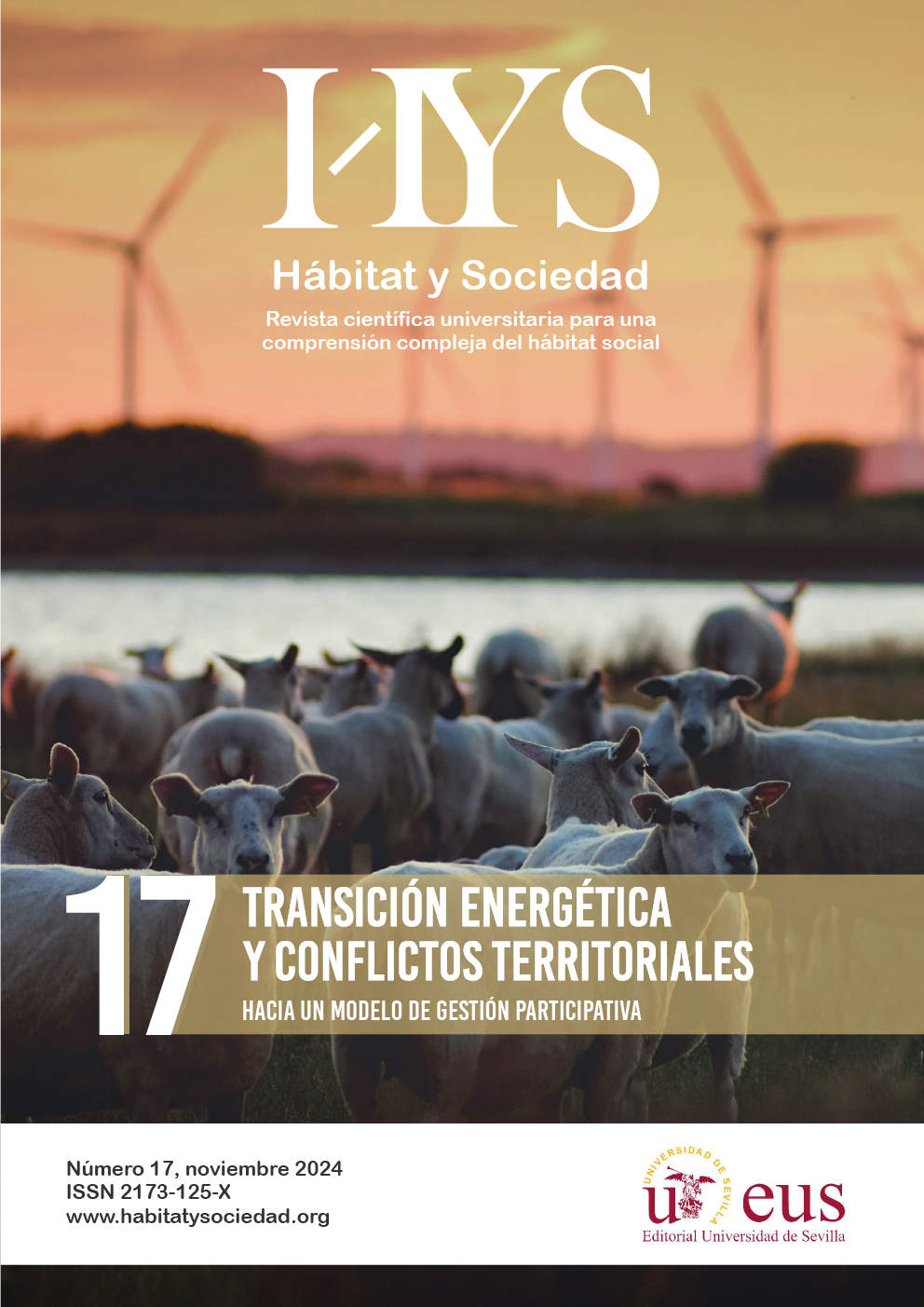
Energy transition and territorial disputes: towards a participatory management model. Introduction to the issue
DOI:
https://doi.org/10.12795/HabitatySociedad.2024.i17.01Keywords:
Energy transition, eco-social transition, European Green Deal, extractivism, environmental deterioration, climate changeAbstract
As a result of the depletion of cheap fossil fuels and increasing evidence of the climate crisis caused by the large-scale burning of these energy sources since the Industrial Revolution, the ‘energy transition’ is a joint undertaking involving both institutional political stakeholders and predominant political groups within the general population. However, despite being signatories to the broad consensus known as the ‘Green Deal’, institutional stakeholders are failing to actually replace fossil fuels, preferring instead to advocate their ongoing intensive consumption – a consumption that continues to increase, with the complementary presence of wind and solar energy. As a result, what we are witnessing is not an energy transition, but rather an energy expansion. No one is questioning (and much less attempting to correct) our ‘imperial lifestyle’, which is based on extremely high energy and material consumption levels. Moreover, the industrialist maxim that more energy consumption automatically leads to greater wellbeing remains intact.
This ‘energy transition’ has alarming social and territorial implications, such as an increase in mining activities and their justification, particularly in certain regions of the Global South (extractivism), and the consequent consolidation of the attitude that views former colonies (as well as other regions that are slowly being encroached on as the boundaries of the mining grounds themselves and the sinkholes of waste that they generate spread ever wider) as areas to be sacrificed. In our text, we offer a critique of this so-called ‘transition’ strategy, touching upon key points that form the framework of the case study upon which this monograph focuses.
Downloads
References
Almazán, Adrián. y Riechmann, Jorge (2023). Desafíos poliéticos de las transiciones energéticas. Arbor, 199(807), a689.
Carpintero, Oscar y Frechoso Fernando (2023). Energía, sostenibilidad y transición: nuevos desafíos y problemas pendientes. Arbor 199(807) a687.
De Castro, Carlos, Mediavilla, Margarita, Miguel, Luis Javier, Frechoso, Fernando (2023). Global solar electric potential: A review of their technical and sustenable limits. Renewable and Sustenable Energy Reviews, 28, 824-835.
Franquesa, Jaume (2023). La transición energética no existe. El Salto. Recuperado el 14 de octubre de 2024 de: https://www.elsaltodiario.com/energias-renovables/jaume-franquesa-transicion-energetica-no-existe
Goldfrid, Delfina y Arroyo, Juan Ignacio. (2022) Elefantes en la transición energética. CEPE Di Tella.
Pérez, Alfons. (2021). Pactos verdes en tiempos de pandemias. El futuro se disputa ahora. ODG, Libros en Acción e Icaria Ed.
Riechman, Jorge (2023). Sobre transiciones energéticas y transiciones ecológicas. Viento Sur. Recuperado el 10 de octubre de 2024 de: https://vientosur.info/sobre-transiciones-energeticas-y-transiciones-ecologicas/
Turiel, Antonio, Bordera, Juan y Pérez, Alfons (2022). España, colonia energética del norte de Europa. Ctxt – Contexto y Acción. Recuperado el 10 de octubre de 2024 de: https://ctxt.es/es/20220601/Firmas/39888/Juan-Bordera-Antonio-Turiel-Alfons-Perez-escasez-energetica-Espa%C3%B1a-Alemania-hidrogeno-verde-Ucrania-Argelia.html
Turiel, Antonio (2022). Sin energía. Pequeña guía para el gran descenso. Alfabeto Editorial.
Valero, Alicia, Valero, Antonio, Calvo, Guiomar (2021). Thanatia. Límites materiales de la transición energética. Prensas de la Universidad de Zaragoza.
Published
How to Cite
Issue
Section
License
Copyright (c) 2024 De los autores y Editorial Universidad de Sevilla

This work is licensed under a Creative Commons Attribution-NonCommercial-ShareAlike 4.0 International License.
Los textos publicados se considerarán propiedad intelectual de los autores y de la revista. Podrán ser usados para usos educativos y académicos, citando al autor y la publicación, con la dirección electrónica exacta. En todo caso, deberá comunicarse este tipo de uso y pedir la autorización del mismo a la dirección de la revista.
Los autores/as que publiquen en esta revista aceptan las siguientes condiciones:
- Los autores/as conservan los derechos de autor y ceden a la revista el derecho de la primera publicación, con el trabajo registrado con la licencia de atribución de Creative Commons, que permite a terceros utilizar lo publicado siempre que mencionen la autoría del trabajo y la primera publicación en esta revista.
- Los autores/as pueden realizar otros acuerdos contractuales independientes y adicionales para la distribución no exclusiva de la versión del artículo publicado en esta revista (p. ej., incluirlo en un repositorio institucional o publicarlo en un libro) siempre que indiquen claramente que el trabajo se publicó por primera vez en esta revista.
- Se permite y recomienda a los autores/as publicar su trabajo en Internet (por ejemplo en páginas institucionales o personales) antes y durante el proceso de revisión y publicación, ya que puede conducir a intercambios productivos y a una mayor y más rápida difusión del trabajo publicado (véase The Effect of Open Access).