Other People’s Dreams / Los sueños de otras personas / Os sonhos de outras pessoas
Ivett, Lee1; Stefanescu, Ecaterina2
1.University of Lancashire, London School of Architecture, London, United Kingdom, laivett80@gmail.com, https://orcid.org/0000-0002-4287-6145
2.University of Lancashire, The Grenfell-Baines Institute of Architecture, Preston, United Kingdom, estefanescu@lancashire.ac.uk, https://orcid.org/0009-0004-7047-7784
Received: 24/06/2025
Approved: 13/09/2025
DOI: https://dx.doi.org/10.12795/astragalo.2025.i39.11
Abstract
Architects work at the service of other people. We are engaged to make real the dreams of others, but those people and their dreams have become more and more privileged, and the architect's role more focused on meeting the needs of privileged elites. Architecture therefore finds its purpose as either lifestyle or spectacle but only to those that can afford it or profit from it, rather than being the tool through which we manifest something positive for all people all the time. Most architectural practice in the UK is complicit in perpetuating this culture of architectural production, a culture that fails to incentivise creating sustainable, lasting, healthy, equitable and accessible places. Preparing students for practice in this culture only perpetuates this unsustainable and inaccessible industry. Instead, this paper proposes alternative modes of practice and associated pedagogies that prepare students to be a different kind of architectural practitioner. It will present the ongoing work and impact of Other People’s Dreams, a live-action research office and final year Master of Architecture studio at the University of Lancashire. OPD engages in a critical and durational way with community organisations in the northwest region of the UK that work with marginalised groups, situations and ideas, to rethink the potential of people and place. This work and its context are then used as a pedagogical framework for the students, who are themselves often from the same communities and from the same ‘real world’ that we wish them to address through architectural education and practice.
Key words: co-production, situated practice, live-action, tacit knowledge, community.
Resumen
Los arquitectos trabajan al servicio de los demás. Nos comprometemos a hacer realidad los sueños de otros, pero estas personas y sus sueños se han vuelto cada vez más privilegiados, y el rol del arquitecto se centra más en satisfacer las necesidades de las élites privilegiadas. Por lo tanto, la arquitectura encuentra su propósito como estilo de vida o espectáculo, pero solo para quienes pueden permitírselo o beneficiarse de él, en lugar de ser la herramienta a través de la cual manifestamos algo positivo para todas las personas en todo momento. La mayor parte de la práctica arquitectónica en el Reino Unido es cómplice de perpetuar esta cultura de producción arquitectónica, una cultura que no incentiva la creación de lugares sostenibles, duraderos, saludables, equitativos y accesibles. Preparar a los estudiantes para ejercer en esta cultura solo perpetúa esta industria insostenible e inaccesible. En cambio, este artículo propone modalidades alternativas de práctica y pedagogías asociadas que preparan a los estudiantes para ser un profesional de la arquitectura diferente. Presentará el trabajo en curso y el impacto de Other People’s Dreams, una oficina de investigación en vivo y estudio de último año de Máster de Arquitectura en la Universidad de Lancashire. El OPD colabora de forma crítica y duradera con organizaciones comunitarias del noroeste del Reino Unido que trabajan con grupos, situaciones e ideas marginadas para repensar el potencial de las personas y el lugar. Este trabajo y su contexto se utilizan como marco pedagógico para los estudiantes, quienes a menudo pertenecen a las mismas comunidades y al mismo mundo real que queremos que aborden a través de la formación y la práctica arquitectónicas.
Palabras clave: coproducción, práctica situada, acción en vivo, conocimiento tácito, comunidad.
Resumo
Os arquitetos trabalham ao serviço de outras pessoas. Estamos empenhados em tornar realidade os sonhos dos outros, mas essas pessoas e os seus sonhos tornaram-se cada vez mais privilegiados, e o papel do arquitecto centrou-se mais em satisfazer as necessidades das elites privilegiadas. A arquitetura encontra, portanto, o seu propósito como estilo de vida ou espetáculo, mas apenas para aqueles que podem pagar por ela ou lucrar com ela, em vez de ser a ferramenta através da qual manifestamos algo positivo para todas as pessoas o tempo todo. A maioria dos gabinetes de arquitetura no Reino Unido são cúmplices na perpetuação desta cultura de produção arquitetónica, uma cultura que não consegue incentivar a criação de lugares sustentáveis, duradouros, saudáveis, equitativos e acessíveis. Preparar os alunos para a prática nesta cultura apenas perpetua esta indústria insustentável e inacessível. Em vez disso, este artigo propõe modos alternativos de prática e pedagogias associadas que preparam os alunos para serem um tipo diferente de arquiteto. Apresentará o trabalho em curso e o impacto do Other People’s Dreams, um gabinete de investigação em tempo real e estúdio de mestrado em arquitetura do último ano da Universidade de Lancashire. O OPD envolve-se de forma crítica e duradoura com organizações comunitárias da região noroeste do Reino Unido que trabalham com grupos, situações e ideias marginalizadas, para repensar o potencial das pessoas e do lugar. Este trabalho e o seu contexto são depois utilizados como uma estrutura pedagógica para os alunos, que são muitas vezes das mesmas comunidades e do mesmo "mundo real" que desejamos que abordem através da educação e da prática arquitetónica.
Palavras-chave: coprodução, prática situada, ação ao vivo, conhecimento tácito, comunidade.
1. Introduction
This paper proposes alternative modes of practice and associated pedagogies that prepare students to be a different kind of architectural practitioner. It presents the ongoing work and impact of Other People’s Dreams, a live-action research office and final year Master of Architecture studio at the University of Lancashire. OPD engages in a critical and durational way with community organisations in the northwest region of the United Kingdom that work with marginalised groups, situations and ideas, to rethink the potential of people and place. This work and its context are then used as a pedagogical framework for the students, who are themselves often from the same communities and from the same ‘real world’ that we wish them to address through architectural education and practice.
Architecture, too often, finds its purpose as either lifestyle or spectacle but only to those that can afford it or profit from it, rather than being the tool through which we manifest something good for all people all of the time. In the UK specifically, the context of architectural production, and by extension, education, has moved away from a civic and social goal for the general public, and has prioritised profit, efficiency, income generation and an alignment with the marketplace (Awan, Schneider, and Till 2011). Alongside this process of commodification, architecture as a profession is also elitist, absorbed in its own isolated self-importance, sheltered by its reliance on jargon, impenetrable theories and self-reference (Harper 2020).
Other People’s Dreams proposes an alternative purpose for architecture and indeed architects. The practice and pedagogical framework and the work presented in this paper is situated in non-metropolitan and non-affluent communities and is focused on the enhancement of everyday life, based on concepts of “learning through doing” and “thinking through making”. We re-situate the role of the architect as a facilitator for other people’s dreams. Not, perhaps, dreams of acquisition and consumption, but dreams of sustenance, wellbeing, purpose and creative production. Within any discourse that concerns itself with the preparation of architectural education for practice it is critical that we first ask ourselves: What kind of practice that is? For whom do we wish to practice and to what end?
2. Architectural context
The post-war era promised, and for a time provided, a scenario of industry, employment, housing and public services, with the role of architecture and the architect in designing and implementing this vision clear and apparent. This is perhaps best illustrated by the fact that in 1976, 49% of all architects worked in the public sector (Highfield 2025). By the 1980’s, film and other media speculated on a future of hoverboards, cities in the sky and floating cars, yet as we moved into the 90’s and noughties, it became apparent that what we were actually going to get was volume housebuilder developments spreading like a virus of banality on the outskirts of our towns, along with disconnected infrastructure and big box retail parks reliant on car ownership for access (Ing 2020) (Fig.1). The private sector replaced the public sector as the instigator and the developer of our shared built environment and by the 2020’s only 1% of architects still worked within the public sector (London Metropolitan University n.d.). Our own actions and outputs as architects can end up perpetuating and increasing inequality even when it might not be immediately obvious. Our potential role as a public or societal servant, assisting those that might need us the most, has been reduced to a role serving those who probably need us the least, feeding either ego or profit at the expense of our health, well-being and sustenance.
As a profession, we seem trapped in a cycle of trying to produce the least worst instead of delivering what we know to be the best. The potential and actual quality of our shared built environment has been constantly diminished, and all these are symptoms of a systemic failure that lowers the aspirations of common society and stifles creativity, innovation and agency in favour of dysfunctional bureaucracy that breeds a culture of mediocrity amongst the disciplines of planning, architecture and urban design (Stewart 2014; University College London 2020).
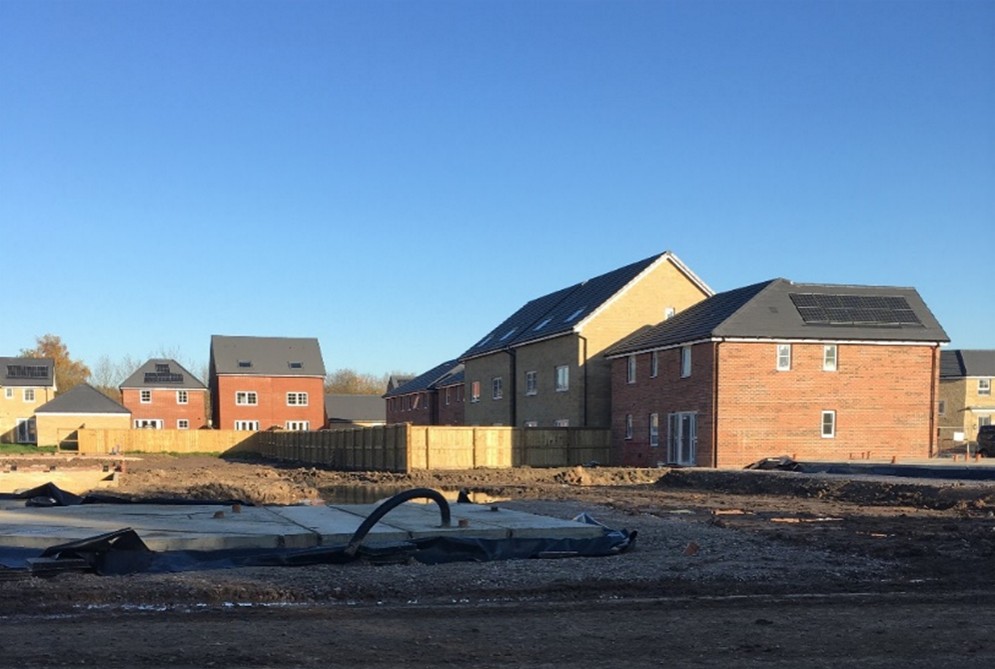
Fig. 1. A virus of banality: non-descript volume housebuilder development getting built outside Preston, 2022. Sources: Author’s own
We therefore find ourselves working and living within a social, economic and cultural condition that is fearful of ideas and agency, and where the general public have been conditioned to believe that architecture is not something for ‘them’. It’s something “other” – for other people, for other places. It is either lifestyle or spectacle – Grand Designs or a Guggenheim Museum, instead of aspects that are harder to define, like social value, durational engagement or the process of making. (Awan, Schneider, and Till 2011). Architecture is also often the go-to media scapegoat for many of society’s ills: slums, schemes, sink estates, schools that fall apart, museums that cost too much, skyscrapers that blight our views (Winston 2016). Buildings are seemingly to blame, not politics or economics.
Currently, in some parts of the UK, like Glasgow’s Gorbals, marginalised neighbourhoods are on their third or fourth wave of demolition and resurrections in the space of a 120 years (ScotCities n.d.). These are places where tenements and terraces replaced pre-Victorian slum conditions to provide decent housing for workers, which were then knocked down to be replaced by the modernist dreams of tower blocks and streets in the sky, which in turn are now being demolished and replaced by the same type of tenements and terraces that preceded them. In reality, the typology of the architecture – whether a terrace, a tower block, a semi or a studio – is not what is relevant; it is instead the economic, political, social and cultural conditions of place that determine the success of the architecture, and not the other way round. If we can learn anything from the last 150 years of development in our collective built environment, it should be that a generational and cyclical process of demolition and re-making or ripping it up and starting again does not lead to sustained and maintained changes in the wellbeing, empowerment and opportunities for those most marginalised and most peripheral within society.
Within this context and presented as a solution to the proliferation of poor ‘places’, Placemaking has been proposed as a methodology through which these concerns might be addressed. Placemaking attempts to determine what might make a great ‘place’ through higher levels of engagement and consultation with people that live in a neighbourhood or community, positioning those people as ‘experts’ that might better inform regeneration processes of their wants and desires (Project for Public Spaces, n.d.). However, Placemaking has now become a linguistic trope within the context of community renewal and regeneration. Whilst seeking to enact physical change in the built environment that avoids mono-economic and mono-cultural homogenous development, it is still a process that relies heavily on creating conditions for external investment from private interests and seeking acquiescence for the imposition of a ‘vision’ or the ‘masterplan’ (de Graaf 2023). Community consultation increasingly adopts processes and attitudes which appear to emotionally coerce members of the public into providing information and knowledge through obscure exercises in mapping, game playing, post-it-notes and questionnaires, later to be disseminated back to the community by ‘professionals’ as banal phrases, good intentions and pithy hashtags (Ivett 2021). Whilst communities and the third sector are invited into these processes as consultees and participants, it is very rare that they themselves end up genuinely owning and having agency over both the process and the result of any change that subsequently occurs, as discussed in Sherry Arnstein’s work from 1969, A Ladder of Citizen Participation. It is often the case that Placemaking is a precursor to differing levels of gentrification and social cleansing; it isn’t actually the underlying causes of marginalisation, poverty and deprivations that are changed, but the people themselves.
In The Production of Space, Henry Lefebvre argues for a type of architecture (or space) that is social and dynamic (1991). A durational and collaborative process, in which the contribution of other, non-professional actors is acknowledged in the process of design and architectural production, is one that allows for a truly collaborative, participatory making of place, at various stages of this process rather than only the initial ones (Awan, Schneider, and Till 2011). Instead of working within the context of the contrived, abstract and often unrepresentative realities of contemporary participatory practice – through an enforced collection of words, pictures, phrases, sketches – we believe in a process of participating in many aspects of a place through the act of making, in order to create an embedded and responsive process of critical, creative and immediately responsive enquiry and action: architecture as advocacy. So how can we conceive and propose new infrastructures of place which ensure that renewal and repair are a holistic, organic and responsive component of everyday life, that is conceived and enacted by the people of that place? How can the potential and the necessity for sustainable and sustained change be identified, actioned and manifested by those that reside and work within the place itself, rather than be imposed by those out-with, for the economic benefit and empowerment of people, institutions and other actors unseen and remote from the place itself? And as educators, how can our role be to prepare our students to be instigators of this ambition and potential paradigm shift in the way in which we conceive, design and deliver architecture and the built environment, rather than become complicit within a broken system and culture of practice and production?
3. Architecture education and being practice-ready
Within this professional context it is interesting to consider that architectural education is also wrestling with similar issues of access and participation. In parallel to the industry, within architecture schools, validation, acceptance, and recognition is often obtained through participating in behaviours, use of language, visual conformity and theoretical dogma that is disenfranchising and marginalising for those not from academic, financial, social or cultural privilege (Harper 2020). The outcome has been a dogmatic educational experience that required the adoption and acceptance of very particular theories and a veneration of very specific buildings, individuals, and critical texts, in order to be validated by peers, tutors and the profession. This can make architectural education and the profession itself feel inaccessible and disempowering to many, especially those from working class backgrounds. Instagram meme account Dank Lloyd Wright is one platform that satirises this culture that encourages and perpetuates reciprocal but insulating support, and the elitism of academia that detaches the architectural profession from everyday life and society (Brillon 2020). So, at this point, we might also consider whether it has been the ills of architectural education that have informed such an imperfect built environment, or the need to prepare our students for this culture and environment of professional practice that has informed a less than satisfactory culture of architectural education. Perhaps we are trying to break free from a destructive feedback loop.
We as educators are currently preparing our students for a culture of practice that is producing mediocre architecture within stressful and underpaid work conditions. Latest surveys of the architecture profession by the RIBA and the ARB revealed that architects in the UK are “underpaid, overworked and undervalued”, unhappy about workplace culture and low pay, and that architectural education also seems to reflect and perhaps precede the cultures, behaviours and conditions found in practice (ARB 2024). It appears to us that architecture, and by extension, the role of the architect, has become massively undervalued in the UK and therefore our role as educators should be focused on seeking ways in which we can prepare our students to disrupt the status quo, rather than becoming complacent or complicit.
Despite such negativity over the current status of architectural education and practice, it is however important to recognise that over the past ten years there has been a growing and ever more robust challenge to the status quo. Decolonising and decarbonising the curriculum have become common phraseology, and educational and professional advocacy/activist groups have been established to force a greater awareness and greater space for women and ethnic groups (Chiganze et al. 2021). There are also various groups that demand that the profession recognise architecture as collective labour and demand more inclusive, democratic, and sustainable ways of practicing and building: the installation by The Architecture Lobby at this year’s Venice Architecture Biennale addresses these bad working conditions, as did the Czech Pavilion Project “The Office for a Non-Precarious Future” at the previous Biennale (Niland 2025; Czech Pavilion Biennale 2023). Social media also platforms these issues, for example revealing instances of unpaid interns used for flagship projects by famous architects like Junya Ishigami (Jonze 2019). Even with this growing diversity and representation, however, new and existing behaviours of conformity are established and persist that still exclude those from certain socioeconomic backgrounds, and only accept those with a very particular type of academic profile.
4. Architecture schools as civic resource
The pressure and the responsibility to prepare architecture students for industry/practice has not only reduced the level and impact of criticality that is applied to architectural education but has also diminished the extent to which we consider our universities and architecture schools as a civic entity and resource (Crompton and Higgins 2025). Since the introduction of tuition fees, Universities have also found themselves in the position of having to generate sustainable income streams within a system that now incentivises the recruitment of international students (Raven 2025). The relevance of a university in relation to the needs of its immediate community are becoming less apparent and less certain.
As opportunities for architects to be employed in the public sector became ever less, some architects did try and find alternative modes of practice that might be more explicit in their desire to serve public need and particularly those communities that suffered from increased levels of marginalisation and deprivation. Community Technical Aid centres emerged in the UK in the second half of the 20th century as one such alternative form of practice, in response to the lack of accessible professional design and planning services for underrepresented communities (Sanoff 2006). These services enabled local groups to shape their environments through affordable, collaborative support from architects, planners, and other specialists. Organised as independent cooperatives and not-for-profit agencies, CTAs offered a range of services—from feasibility studies and minor renovations to public spaces and community buildings. Examples such as Comtechsa in Liverpool and CLAWS in London demonstrate how the combination of public funding, grant funding and grassroots organisation enabled architects, planners, and technicians to support local initiatives (Wates 1983). CTAs became a significant counterpoint to top-down redevelopment and mass housing schemes that replaced earlier slum clearance programmes. They promoted a shift in the professional role of the architect, emphasising collaboration, user control, and embedded practice over detached expertise (Awan, Schneider & Till, 2011). However they remained under-supported within mainstream practice, and their decline in the mid- 1980s coincided with a political preference towards attracting private investment, the ‘market’ and trickle-down economics as means of addressing social and economic decline. This shift then became a catalyst for the withdrawal of public funding and as of 2025 none remain in the UK (Wates 1983).
More progressive and radical groups within architectural education also tried to respond to this need to address growing inequality and social deprivation, often becoming pivotal supporters or even instigators of alternative modes of practice. Groups like Support Community Building Design, formed by Architectural Association students, and Assist, affiliated with the University of Strathclyde’s architecture department, directly linked academic practice with grassroots activism (Awan, Schneider & Till, 2011).
These examples offer a useful and inspiring precedent for our own Other People’s Dreams project, demonstrating strategies and methodologies for bringing together architecture schools with community groups through the establishments of collaborative research, knowledge exchange and project offices. Whilst the radical intent of many of these initiatives has also disappeared from architectural education, the idea of a Project Office, and by extension, the Live Project, has continued to gain traction within architectural education. These initiatives are aimed at providing design and research collaborations that replicate the experience of practice within academia in order to expose students to the realities of a professional career in architecture, before they move entirely into industry. They have been set up to work on a pro-bono or reduced-fee basis with community organisations and the third sector, providing architectural services and bridging the gap between academic learning and real-world application (Stott 2025). The so-called “third wave” of Project Offices emerged around 2010 as potentially an answer to the 2007 financial crash and the need for alternative modes of practice for the students, as well as a critical shift in pedagogy arguing for a more socially engaged architecture. It includes those at Leeds Beckett University, London Metropolitan University, the University of Sheffield, and other initiatives across the UK architecture higher education, who have more recently come together for the Project Offices Forum, which took place at Newcastle University on 10 September 2024 (University of Portsmouth 2024).
However, many of these initiatives face criticism related to ethical concerns, skill gaps, and the nature of architectural education itself, with some arguing that the way project offices can blur the lines between education and professional practice is potentially exploiting students for free labour, competing unfairly with architectural firms, and virtue signalling (Wilson 2023). Although largely positive, a review by University of the West of England titled Live Projects Impact Review & Project Office Pilot Study highlighted concerns around student workload and time pressures, as live projects often demand significant commitment alongside other academic obligations. Ethical complexities also arise, particularly where students engage with real clients, creating confusion around authorship, liability, and professional responsibility. The integration of live projects into academic assessment frameworks also presents tensions, and the report notes the resource-intensive nature of this model, which requires consistent staffing, funding, and institutional support to remain viable and impactful over time. And crucially, there is an awareness that live projects and project offices rely heavily on strong, often long-term community relationships, which require considerable maintenance for the sustainability of partnerships, with institutional memory loss and staff turnover posing risks to long-term collaboration (Burch et al 2025). At the same time, although originally envisioned to provide cheap or pro-bono architecture services and support to grassroots and community organisations, the concept of the ‘live-project’ has now grown to include clients such as town and city councils and large urban developers – organisations that can and should be paying for professional services, as seen in the list of clients for the more recent MSA Live programme ran at the Manchester School of Architecture (Manchester School of Architecture 2024).
5. Other People’s Dreams as alternative
Within our architecture school (Grenfell-Baines Institute of Architecture) we believe in the power of architecture and its associated discourse to be the primary tool through which we might create a more equitable, accessible and just world. We position architecture and spatial practice as the critical societal tool through which we might create instances of delight and opportunity in the everyday and through which we elevate all people’s experience of ordinary life in extraordinary ways. We consider architecture to be a public matter: from the way students are taught and studio briefs are written, to the public engagement in live-action research projects with a civic theme, we also propose the act of making as a means of creating ever more inclusivity and accessibility to architectural education and the profession, and suggest that an experience of learning-through-doing and thinking-through-making disseminates knowledge and generates skills in a way that has the potential to make architecture accessible to all.
Through the act of making, anthropologist Tim Ingold argues that the maker at once exists as observer and participant, and there is no differentiation between implicit knowledge and told, articulated knowledge (2013). Through practice and experience, the transfer of knowledge between the different actors involved in this process takes place and the maker, through the object and the process, simultaneously observes, documents, learns and analyses. Richard Sennet also talks about the ‘evolutionary dialogue between the hand and the brain’ and argues for the tacit knowledge created by ‘hand habits’ (2009, 151, 10). This process positions the maker explicitly as a participant in the existing life of a place, observing its condition and creating insight that is not predictable, and which is genuinely learnt through experience. This mode of practice, seeking to create curiosity and participation through the making of objects, artefacts and scenarios, allows an embedded register and reflection on the dynamics and culture of people and place.
Henry Sanoff (2006, 13-14) refers to the process of ‘deliberation’ that is crucial for different and potentially divergent voices to be heard within the democratic co-design process. We see, however, the process of hands-on making with community members and participants as the most appropriate act of ‘deliberation’. The risk of apathy emerging in the participatory process is countered by the involvement of the community at any and every stage: in the ‘visioning’ process that Sanoff refers to, but also the immediate and physical act of modelmaking, testing, moving and building. The architect, as the professional, is in charge of facilitating decision making, but we see that the best way that can be achieved is with the scalpel or the drill, as the immediacy and dynamism of the process allows for results and consequences to be instantly apparent. The risk of such a method is countered by the opportunity for a truly ‘fair, open and democratic’ decision-making process (Sanoff 2006, 15).
This methodology, borrowing from ethnography and anthropology, seeks to engage actors who are usually marginalised and left out of the normative ways of research and consultation. This type of analysis reimagines the made and the built as a continuous and ever evolving register of life and experience; we believe that the marks, scars, reactions and interventions created by the actions of individuals, collectives and institutions create a story of place that can be read and interpreted as if they were chapters in a book. In the same way that Sennet and Ingold articulate the potential, through making, for the individual to gain knowledge and insight, communities of people and place might collectively acquire and retain knowledge through shared, collaborative, situated and participatory making. In their work Spatial Agency: Other Ways of Doing Architecture, the editors refer to Anthony Giddens’ term ‘mutual knowledge’, founded in ‘exchange, hunch and intuition’, which is shared through practice and knowledge embedded in the everyday (Awan, Schneider, and Till 2011, 32). The act of making is then both representational and interventional, and as such becomes transitional, offering a means of suggesting and testing new possibilities which are generated by the very people of that place. It is re-positioned not as a finite act, but as a series of empathic and responsive actions that situate the actor/maker within the physical, cultural and social conditions of ordinary life. Participation in architecture is therefore a symbiotic mode of practice, whereby the architect is as much a participant in the context that they are exploring, as the community they are engaging with is a participant in the design process.

Fig. 2. Ivett. Other People’s Dreams framework Diagram, 2025. Source: Author’s own.
Other People’s Dreams is based within the Grenfell-Baines Institute of Architecture and operates simultaneously as a live-action research office and Master of Architecture course. OPD is a vehicle for agency and action within the context of these wider institutional aims and ethos, and it is intended to practice what we preach and extend our commitment to learning through doing and thinking through making outside of the academic setting. It is less concerned with what it defines itself as in terms of a practice, studio, office or entity, but it is not a business, as it does not seek to replicate the experience and culture of contemporary practice; rather it is practice as process and advocacy.
To counteract architecture’s role in perpetuating the political, economic and social power of elites, Other People’s Dreams has been established to consolidate and synthesise several years of relationship building with local community arts organisations into a clear and discernible entity of real knowledge exchange between the academic, the student and our immediate communities in the northwest, all learning together in real time, in a condition of mutual benefit and respect. We engage in a critical and durational way with organisations to explore modes of participation with marginalised groups, situations and ideas, and we explore that which is often 'unseen' within architectural education: everyday life as experienced by everyday people, born and often made peripheral through birth, migration, poverty and happenstance.
OPD asks what is a shared built environment for those that might sustain themselves and each other? For those that work where they live, and live whilst they work? To answer these questions, we utilise active participation and what we call co-production to conceive and create architectural and spatial interventions. We prefer the term co-production, borrowed from public service delivery and policy development, to the more popular co-design, because it concerns all aspects of the process: from proposal and planning, to the building, delivery and consequent use of a project; a collaborative approach that moves away from top-down processes to create real inclusive, hands-on involvement and outcomes (SCIE, n.d. ; Designing Buildings Wiki, n.d.). These projects allow local people to test new possibilities, activities and infrastructures within the places that they live, work and play, leading to greater agency, autonomy and empowerment. The work we produce is specifically situated outside of the metropolitan areas, focusing on the edges, the post-industrial, and the suburban, with projects based in Blackpool, Blackburn, Nelson, Coniston, Fleetwood and Skelmersdale. The distinct and shared characteristics of these contexts are exceptionally important to us; they are not big city contexts; they are communities that have suffered from the sustained decline of an economy and that seek to establish a contemporary identity and encourage investment and regeneration.
These communities are also the communities from which many of our students come from, and an additional rationale for engaging in these types of places is to encourage our students to believe in these places as contexts within which an aspirational and impactful career in architecture can be realised. Countering the ‘brain drain to London’ and other metropolitan areas, we believe that the most interesting, critical and life-affirming place to be an architect in the world right now is no further away from the end of your fingertips and the land beneath your feet (Waite, 2023). We aim to show that the realisation of their dreams and the impact students seek to have does not need to be anywhere else but right here, right now, in their immediacy and community.
In Preston, at the University of Lancashire, our architecture school is surrounded by competitor institutions in big cities such as Manchester and Liverpool, and prestigious universities in smaller cities such as Lancaster. Our ability, and even our desire, to flood our courses with international students is not at all comparable. The University has a higher proportion of students that are local, and the first in their families to access higher education (Holmes 2020). So, in fact, we consider an ever-greater level of hyper-localised engagement as being critical not only for our survival as an institution in terms of widening participation and maintaining recruitment, but also as a resource from which those communities might access skills, knowledge and technologies that benefit their social, cultural, environmental and economic wellbeing.
The development of Other People’s Dreams is an evolution of the co-creation and co-production work we have been engaged in for the past 4 years, which include collaborative projects with third sector organisations LeftCoast (Blackpool), Super Slow Way (Nelson and Blackburn), Grizedale Arts (Crake Valley) and Glassball Studio (Skelmersdale). The prototype was Wash Your Words: The Langdale Library and Laundry Room in Blackpool. The project established a new type of community amenity space, combining essential services encompassing a local library, a shared community launderette and flexible spaces for creative activities, meetings and consultations, with the opportunity to co-produce the space with the community within which it is situated. The project, commissioned by LeftCoast, was co-designed and self-built between 2021 and 2023. Located in Mereside, a peripheral social housing estate in Blackpool suffering from multiple indicators of social and economic deprivation, the project connected the marginalised community with the skills and resources available in an academic setting, fostering knowledge transfer and community impact. Through an embedded and active approach to community engagement, we worked with the residents and stakeholders of Mereside in the design decision-making process to ensure that everyone shared a feeling of mutual ownership of the neighbourhood amenity, creating greater community cohesion through collaborative action (Ivett and Stefanescu 2022). This ethos was evident in the co-design workshops – held in the derelict site of the future library and laundry room, utilising existing furniture, taking building elements apart, and interacting live with a scale model – and reinforced during the construction stage, in which volunteers and residents demolished, re-built, fabricated and decorated the spaces and the furniture, contributing over 90% of the labour. By engaging with the digital fabrication and workshop facilities at our university, we introduced participants to new knowledge and skills related to contemporary craft and making (Fig. 3). The project was recognized and highly commended in RIBA Journal’s MacEwen Award for socially-responsible architecture and won the Sustainable Green Initiative Award at the 2024 Educate North Awards for Higher Education (Kucharek 2023; Educate North Awards 2024).

Fig. 3. Stefanescu and Ivett. Wash Your Words: Co-design workshop with residents on site, the construction process and the space in use. 2022. Source: Author’s own.
This project became the catalyst for a practice and pedagogical framework that combines working within marginal contexts, for third sector organisation clients, and with residents, users and local stakeholders, to enhance the provision of an architectural education which utilises the physical act of making to change perceptions around spatial agency and architectural outcomes, build capacity and agency within communities and widen participation in the academic environment (Fig. 2).
6. Case studies
Following the success of Wash Your Words, we undertook a series of projects that are on-going, continuing and strengthening the partnerships between the academic institution and the third sector.
6.1 The Ripple Effect: community pop-up structures along the Leeds-Liverpool Canal
This project was a collaboration between Other People’s Dreams, arts organisation Super Slow Way, and the Ripple Effect community steering group based in the East Lancashire town of Nelson. Combining local knowledge and skills with academic resources and technology, the project involved the development and implementation of two different forms of architectural intervention. The team of academics and students were engaged to identify, design and then apply a series of small-scale architectural interventions to test ideas for potential programming and activity to provide a resource to the community for testing and then establishing new amenity and activity on under-used sites adjacent to the Leeds-Liverpool Canal in the post-industrial town. One of the interventions was intended to provide a new enclosed small scale civic space in Lomeshaye Park, and the other is a 'kit of parts' that allows the community to self-build a whole variety of different types of structure in a site of urban wilderness, called 'The Bowl', caught between the canal and the M65 motorway.

Fig. 4. Stefanescu. The Ripple Effect: Co-design workshops with stakeholders on site, utilising modelmaking, testing and 1:1 prototyping. 2023. Source: Author’s own.
These projects were initially developed and co-designed with the community in Nelson during a series of practical workshops in Spring 2023. Community participation and collaboration was an inherent part of the process of research, design and making, in order to help build capacity, skills and knowledge amongst the Ripple Effect steering group and wider community. The practical design sessions we delivered on the two sites along the canal involved marking out, role-playing, quick modelmaking and prototyping at 1:1, collaboratively and iteratively developing the interventions for each locations and allowing community members to test and perform various activities and situations with the structures, developing the programme of future activities, and also informing directly the design and adaption of the installations. These co-design workshops were not only meant to try out the structural and experiential aspects of the design but also examine the potential for an active engagement and participation in the process of making (Fig. 4). Including the community in the process was a way of ensuring that they understood the way in which design decisions were informed, and how a response to both constraint and aspiration were influencing the development of the project in terms of its appearance, feasibility and delivery, an application of the concept of ‘deliberative democracy’ discussed by Sanoff (2006, 13).
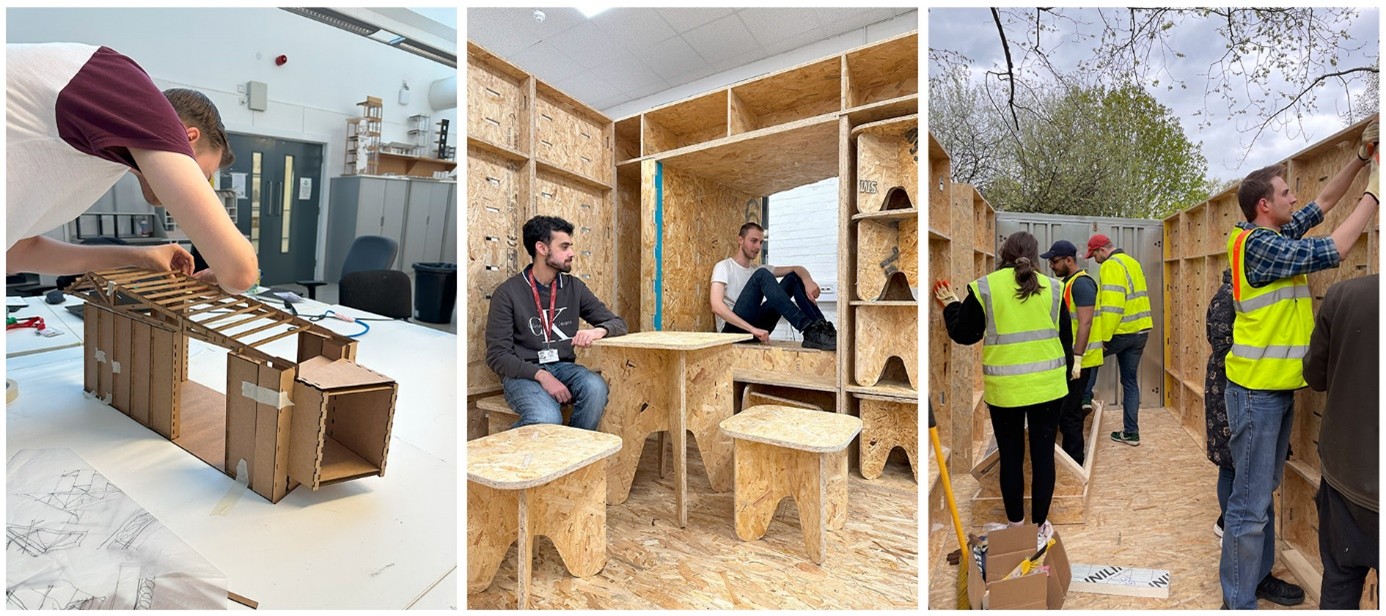
Fig. 5. Ivett and Stefanescu. The Ripple Effect: detailing through sketches and models, fabricating all components using the waterjet cutter by the Master of Architecture students, and the on-site installation of the Pop Up in Lomeshaye Park. 2023-2024. Source: Author’s own
The documented outcomes and learning generated through the design participation stage was utilised to develop the design proposal for a physical intervention in each of the project sites, which were designed to be easily adapted and re-used for a variety of purpose to further test a range of possible social, cultural, economic and environmental activity in each location. The final iteration of the structures was fabricated at the workshops of the university in Preston with Final Year Master of Architecture students throughout the 2023-2024 academic year as a live-action part of their course. The students worked on the detailed proposal with the support of the technical team. This process commenced with a series of iterative sketches and model-making by the students, who then created the files that could be used for waterjet cutting and producing all components. We utilised a large space within which to make and assemble everything at 1:1, and also delivered a series of test sessions with members of the Nelson community on campus to see how the structure could be adapted for different uses. Lessons and insight gained from these sessions then informed further iteration and development of the interior in terms of furniture and storage (Fig. 5). Crucially, the students’ involvement came at the later stage of the design process, and was specifically concerned with the technical feasibility and construction of the structure. This ensured that the ethical and professional concerns regarding the collaboration between community partners and students came at a stage where the relationships were strong and long-term, and there were clear expectations around the final outputs.
The structures were installed on site in the spring of 2024 and throughout the summer, they explored the potential for these green public spaces to encourage natural engagement and play and become important local amenities through resident and artist-led creative workshops and pop up cafes. The Pop-Up cabin in Lomeshaye Park, assembled on site on the 26th of April 2024 with the student group and members of the Ripple Effect steering group, has since hosted bike repair classes and food-sharing activities (Fig. 6). The project is delivering a range of physical, social and cultural activity and has engaged meaningfully with a variety of local people and organisations. The impact of the project has been seen in events that have enhanced the neighbourhood's connection to both the park and the canal, and which are on-going (The Super Slow Way n.d.).

Fig. 6. The Ripple Effect Pop-up on the Leeds & Liverpool Canal, 2024, photography by Jack Bolton, courtesy of The Super Slow Way
6.2 Revoe Public Square: Prototyping Public Space in Blackpool
Revoe Public Square is an ongoing project in collaboration with third sector and arts organisations LeftCoast and Revoelution that prototypes new forms of civic space in a marginalised community in the coastal town of Blackpool, testing new methodologies of reuse and fabrication. The town’s leisure economy is supported by a transitory, low-skill, low- wage workforce, many of whom reside in the Revoe area along Central Drive and see little of the financial revenue returned into this marginalised community, which is one of the most deprived in the country (BBC News 2019).
Revoe sits between two major redevelopments in the town: Blackpool Central, a development based around leisure; and a Sports Village around the existing Blackpool FC ground (Blackpool Council. n.d.). There is a lot of money earmarked for urban renewal, but also a risk that Revoe will be regenerated in inefficient and unsustainable ways. Some of the dire statistics on the economic and social deprivation include: low levels of employment; 27% of residents considered to be in ‘bad or very bad’ health; 36% of the working age population claiming DWP Benefit; higher than average overall crime rate; and a legacy of poor-quality accommodation that is encouraging high levels of transience, resulting in vacancy rates more than three times the regional and national averages (Revoelution and GL Hearn 2020).
The Revoelution Partnership, where this project is taking place, is based at the Revoe Community Centre on Central Drive. It is an informal resident-led group which organises activities and projects that address issues identified by residents in the area (Revoelution n.d.). The area is also home to a large Romanian Roma community which is further marginalised and isolated from the wider community through language and culture, causing instances of tension in the neighbourhood.
The engagement in the area was started with a research project that looked at the how the local Romanian Roma community in Revoe affects architectural space – and vice versa – and how they engage with the existing communal spaces and wider community infrastructure. “Modelling Migrancy and Community” took place in spring 2023 and was funded by the Research Centre for Migration, Diaspora and Exile (MIDEX) at the University of Lancashire. The project used collaborative modelmaking, collaging, drawing and unscripted conversations, which were purposefully situated in the local community centre, to gain insight into the Romanian migrants’ domestic spaces and relationship with personal objects and artefacts, but also into how the community use the civic space available, and ambitions and desires for what new amenities could provide (Fig 7).

Fig. 7. Stefanescu. Artistic research and engagement project with the Romanian Community. 2023. Source: Authors’ own.
Following on from that project, we were asked by Revoelution and LeftCoast to get involved in a project to revitalise an empty piece of fenced-off wasteland next to the community centre. The area has just gone through a series of consultation exercises resulting in a Regeneration Masterplan, which would see most of the neighbourhood regenerated and demolished. The document, however, also revealed the consultation fatigue present in the community, where residents ‘have been consulted to death and nothing ever changes’ (Revoelution and GL Hearn 2020, 34).
The team of academics, the arts organisation and a community group took over the derelict site to co-create a platform, a temporary square on and through which the community can test ideas for the future of community spaces: a provocation intended to allow and encourage the community to demand agency over the future of the area. The former George Hotel that once stood on the site was central to the area’s social fabric, but the pub was demolished in 2020 due to safety reasons, and the land, now privately owned, was fenced off and left to grow wild (Parkinson 2022). As the neighbourhood was ear-marked for regeneration through levelling-up funding, Revoe Public Square (actually a circle) was envisioned to actively engage local people in the development and application of a new temporary public space, giving residents the opportunity to make visible their own ideas and potential impact within these processes of regeneration and exploring the role of public space in facilitating community collaboration and cohesion.
Co-design workshops held on-site in May 2024 revealed a desire for a visually striking object that would subtly invite engagement (Fig 8). The result was a 10m-diameter circle with a 3m hole, a raised platform which functions as a bench, gathering space, and outdoor performance venue. The design incorporates octagonal and square panels, inspired by the form of the adjacent community centre, and is made from decking boards and bespoke concrete terrazzo slabs. The terrazzo was produced with participants at the local community centre in June and July, with larger elements fabricated at the university construction lab supported by our technical team. It includes demolition rubble, glass from the site, and seashells, with colours representing the former pub, the sea and sky, and the beach (Fig. 9).

Fig. 8. Stefanescu. Initial planning and co-design workshops on the former George Hotel site; co-design workshops utilising an adaptable scale model; further co-design sessions, making colour tests and discussing terrazzo. 2024. Source: Authors’ own.
Partly funded by Research Institute for Area and Migration Studies (AMIS) at the University of Lancashire, the project included participants from the local British and Romanian community as well as asylum seekers, testing out new methodologies of community engagement, participation and co-design. This project demonstrates how, at a time of heightened tension across the UK amongst settled and migrant communities, simple acts of collaborative making can bring people together through shared objectives and providing a safe and supportive context through which to raise and address potential points of conflict. Sanoff discussed the challenge of ‘how best to be deliberative within conflictual, adversarial settings’, and how the co-design progress can negotiate around the risk of only listening to the loudest and most aggressive personalities within a community setting (2006 13, 17). Through this durational project, we found that the hands-on aspect of the making process allows for a true ‘deliberative democracy’, with decisions about form, aesthetics and function being made on the spot, with immediate effect, and with input being given by a broad range of community members: long-term residents, temporary asylum seekers, migrant families and people who have not been involved in such a process before, allowing for ‘group ownership’ and an iterative, additive process rather than compromising consent (Sanoff 2006, 18).

Fig. 9. Ivett and Stefanescu.; and fabrication of the square terrazzo panels in the makeshift fabrication workshop in community centre garden with community members and volunteers. 2024. Source: Authors’ own.
The following cohort of Final Year Master of Architecture students also worked alongside the volunteers and residents in the development and delivery of the project during the 2024-2025 academic year. Not only a live-action part of their final year studies, the project was also utilised as a project case study for their Professional Studies module.
The public square was opened during the Revoe Fun Day event on 24 August 2024, where the volunteers and over 100 people were there to place the last terrazzo panel on the platform. Since then, the space has hosted several public events organised by LeftCoast and/or Revoelution, as well as being used day to day for seating, meetings, and informal play (Fig. 10). The work on the space has continued, with new paths and planters added with the help of Architecture students in spring 2025.
The square has transformed what can be offered in terms of collective life in the neighbourhood. The project creates a beautiful space in an area where people can feel uncared for, overlooked and unseen. It represents a radical departure from the normative process of physical regeneration in communities, with no external contractors involved in the project. Work will continue with the community itself to further develop the site as a space and resource that builds a case for local agency, autonomy and ownership within the context of existing and proposed top-down regeneration.

Fig. 10. Ivett and Stefanescu. Revoe Public Square in use. 2024. Source: Authors’ own.
7. Pedagogical framework
Instead of learning within the contrived reality of contemporary participatory practice, we believe in the acquisition of tacit knowledge through acts of participatory making, creating an embedded and responsive process of critical and creative enquiry. Through the application of this method, we gain knowledge through experience. We make. We converse. We collaborate. We Enquire. We observe. We register.
The previous case studies exemplify how durational, situated, collaborative and community-embedded work underpins the pedagogy of the Master of Architecture course at the University of Lancashire. Rather than relying on the ‘live project’ model and framework, OPD creates opportunities for learning and knowledge exchange through engaging students in live situations and territories. The focus is not on an engagement with a singular brief, but an ongoing dialogue with people and place, and with ideas of how those people and communities might become more autonomous and empowered agents of change in their own place. The organisations that we work with are not clients in the traditional sense, they are critical and contextual friends, collaborators that give us and our students as much knowledge and expertise as we give them. Our established and long-term relationships with these organisations provide the following opportunities for student engagement in live situations:
1. A hands-on participation in the development and fabrication of small-scale architectural projects that OPD is delivering with our community partners;
2. The design and detail development of such proposals;
3. Each of the places that we are engaged with acts as site and territory for all our Master of Architecture studio briefs. Students conduct a contextual analysis of each place, with community partners hosting site visits, community engagement activity and presenting the current and historical social, economic, cultural and environmental conditions of the place and its people;
4. Our Critical and Cultural Contexts module then invites our students to create an analytical drawing, accompanying film and essay as a response to each place;
5. Our Year 1 MArch Design Studio brief invites students to select an existing building in the community and propose its adaption into a new infrastructure and amenity of caring, sharing and repairing;
6. Our Year 2 MArch Design Thesis project asks our students to identify the latent and critical concerns of people and place identified through an active participation in those place and engagement with our community partners, and then develop a strategy and a set of interventions to articulate an alternative present and future condition;
7. Our Year 2 MArch Professional Studies module uses one of the physical live projects that the academic team are engaged with to create a scenario where students are required to present their engagement in a project, from conception to completion, in reference to the RIBA Plan of Works. In this exercise they have to speculate and calculate what an appropriate fee would have been, quantify materials and budget for construction costs, produce risk assessments, complete drawings and specifications, report on any requirements for statutory approvals and also conduct post occupancy evaluation.
8. Conclusion
An engagement with our specific communities is woven through all the taught modules, ensuring horizontal synergies across modules in each year, as well as a clearly defined vertical progression narrative from one year to the next. The design studios across both years of Master of Architecture explore theories of ‘Place Making Place’ and 'Making as Care', proposing new forms of neighbourhood and architectural typology that situates hyperlocal, individual and collective acts of making objects, place and community as the primary means of creating individual and collective well-being. We are particularly fascinated by how economies and cultures of making shape and inform our built environment and communities, and we explore these interests by engaging in contextual conditions which tell the story of a societal transition from local utilisation of resources and acts of making, to a present day condition where the production of things we need to sustain and delight life are done by other people in other places.
Within contemporary architectural education and practice there is a tendency towards an attitude that good architecture can only be produced in certain places, with certain clients and with a certain amount of budget. In the UK, these places tend to be large cities or a rural idyll, with the profession and education being exceptionally London-centric. For places and architecture schools outside of London – and indeed outside of other large cities – this can be extremely problematic. Opportunities to enter practice are less, opportunities to work for practices delivering quality work are even less, and therefore a cycle of talent migration away from places like Preston in the northwest becomes inevitable. Other People’s Dreams offers a point of reference and an inspiration and encouragement for other Schools of Architecture that might be situated in similar places and operating within similar conditions. OPD is critically and actively engaged in the issues that are most relevant to our local communities, especially those that are suffering from poverty and marginalisation. It uses an engagement in these contexts to situate our school of architecture as a civic resource, learning from past initiatives of radical, grass-roots practitioners based within architectural education institutions, whilst also ensuring that our students are not only prepared for ‘practice’, but are equipped to develop their own practice such that they can then disrupt and challenge the contemporary cultures of behaviour and production in the UK that currently make the architecture profession a less than ideal and less than satisfactory place to work.
9. References
Architects Registration Board (ARB). 2024. “New Research Published by ARB Reveals Staggering Levels of Discrimination and Sexual Misconduct Experienced by Architecture Professionals.” News release, November 20, 2024. https://arb.org.uk/new-research-published-by- arb-reveals-staggering-levels-of-discrimination-and-sexual-misconduct-experienced-by-architecture-professionals/.
Arnstein, Sherry R. 1969. “A Ladder Of Citizen Participation.” Journal of the American Institute of Planners 35 (4): 216–24. https://doi.org/10.1080/01944366908977225.
BBC News. 2019. “England’s Most Deprived Areas Named as Jaywick and Blackpool.” BBC News, September 26, 2019. https://www.bbc.co.uk/news/uk-england-49812519
Blackpool Council. n.d. “Blackpool Town Deal.” Creating a better Blackpool. Accessed June 2025. https://www.blackpool.gov.uk/Your- Council/Creating-a-better-Blackpool/Blackpool-Town-Deal/Blackpool-Town-Deal.aspx
Burch, James, Eirini Grigoriadou, Georgia Wigmore, and Dr Matthew Jones. 2025. Live Projects Impact Review & Project Office Pilot Study for the School of Architecture & Environment. University of the West of England, January 22, 2025.
Chiganze, Tanyaradzwa, Mohit Buch, Jasmine Lawrence, Harsha Gore, and Flora Jing Lin Ng. 2021. “Takeover: Decolonise Architecture Tackles Institutional Racism Head On.” RIBA Journal (RIBAJ), April 16, 2021. https://www.ribaj.com/intelligence/takeover-decolonise-architecture-tackling-racism-with-education-and-practice-reform ribaj.com+2ribaj.com+2researchportal.bath.ac.uk+2
Compton, Emily, and Sam Higgins. 2025. “Don’t Defund Thinking: Why Architectural Education Needs Space to Question, Not Just Produce ‘Practice‑Ready’ Graduates.” BD Online, July 25, 2025. https://www.bdonline.co.uk/opinion/dont-defund-thinking-why-architectural-education-needs-space-to-question-not-just-produce-practice-ready-graduates/5136781.article.
Czech Pavilion Biennale. 2023. The Office for a Non‑Precarious Future. Accessed July 24, 2025. https://www.czechpavilionbiennale23.com/.
de Graaf, Reinier. 2023. “I Have a Confession to Make: I Have No Idea What Placemaking Is.” Dezeen, September 11, 2023. https://www.dezeen.com/2023/09/11/placemaking-reinier-de-graaf-opinion/.
Designing Buildings Wiki. n.d. “Co-Production.” Accessed July 24, 2025. https://www.designingbuildings.co.uk/wiki/Co-production#:~:text=Engagement%20Overlay%20to%20the%20RIBA,leading%20to%20more%20collaborative%20outcomes.
Educate North Awards. 2024. “2024 Winners.” Accessed July 17, 2024. https://educatenorth.co.uk/2024-winners/.
Harper, Phineas. 2020. “Architecture Has Become an Elitist Pursuit – We Need a New People’s Architecture.” Dezeen, August 18, 2020. https://www.dezeen.com/2020/08/18/architecture-elitist-phineas-harper/.
Highfield, Anna. 2025. “Who Are the Architects Working in Government?” Architects’ Journal, February 26, 2025. https://www.architectsjournal.co.uk/news/who-are-the-architects-working-in- government?utm_source=WordPress&utm_medium=Recommendation&utm_campaign=Recommended_Articles (accessed 21 June 2025).
Holmes, Michael. 2020. “Drop-Out Rates for the University of Central Lancashire (UCLan) Revealed as Boss Says They ‘Compare Favourably’.” Blackpool Gazette, January 6, 2020. https://www.blackpoolgazette.co.uk/education/drop-out-rates-for-the-university-of-central-lancashire-uclan-revealed-as-boss-says-they-compare-favourably-1356088.
Ing, Will. 2020. “Most New Housing So Poorly Designed It Should Not Have Been Built, Says Bartlett Report.” Architects’ Journal, January 20, 2020. https://architectsjournal.co.uk/news/most-new-housing-so-poorly-designed-it-should-not-have-been-built-says-bartlett-report.
Ingold, Tim. 2013. Making: Anthropology, Archaeology, Art and Architecture. London: Routledge.
Ivett, Lee. 2021. “The Act of Making as Participation and Enquiry.”, I am from Reykjavik, accessed October 16, 2022. https://www.iamfromreykjavik.com/portfolio-item/the-act-of-making/.
Ivett, Lee, and Ecaterina Stefanescu. 2022. “Mereside Library/Laundrette Combines Essential Services with Opportunities to Co-Design, Co- Produce, Adapt and Share a Local Amenity.” Oslo Triennale Neighbourhood Index. Accessed August 18, 2022. https://neighbourhoodindex.org/index/53a8ee24-b956-4f9c-8c74-de815769dae9/.
James Brillon, 2022. “Instagram account dank.lloyd.wright aims to "amplify narratives that are excluded from architecture's official consensus",” Dezeen, August 20, 2022 https://www.dezeen.com/2022/08/30/instagram-dank-lloyd-wright-interview/.
Jonze, Tim. 2019. “Row over Unpaid Interns on Serpentine Pavilion Project.” The Guardian, March 22, 2019. https://www.theguardian.com/artanddesign/2019/mar/22/row-unpaid-interns-serpentine-london-gallery-pavilion-architect-project.
Kucharek, Jan-Carlos. 2023. “MacEwen Award 2023 Commended: Wash Your Words Adds Books to Chores.” The RIBA Journal, January 30, 2023. Accessed February 3, 2023. https://www.ribaj.com/buildings/macewen-award-2023-commended-wash-your-words.
London Metropolitan University. n.d. “From Public Service to Private Practice.” Research Projects and Funding, Centre for Urban and Built Ecologies. Accessed 21 June 2025. https://www.londonmet.ac.uk/research/centres-groups-and-units/the-centre-for-urban-and- built-ecologies/research-projects-and-funding/from-public-service-to-private-practice/.
Manchester School of Architecture. 2024. “MSA Live 24.” Manchester School of Architecture. Accessed June 2025. https://www.msa.ac.uk/2024/msalive/.
Niland, Josh. 2025. “The Architecture Lobby Presents Oral History of Labor Organizing at the 2025 Venice Biennale.” Archinect, May 8, 2025. https://archinect.com/news/article/150480026/the-architecture-lobby-presents-oral-history-of-labor-organizing-at-the-2025-venice-biennale.
Parkinson, Shelagh. 2022. “Blackpool’s Heritage to Be Protected from Demolition Risk.” Blackpool Gazette, July 13, 2022. https://www.blackpoolgazette.co.uk/news/politics/blackpools-heritage-to-be-protected-from-demolition-risk-3766266
Project for Public Spaces. n.d. “What Is Placemaking?” Accessed July 24, 2025. https://www.pps.org/article/what-is-placemaking.
Raven, Darren. 2025. [Lecture-Zine 207 - 26/07/25 - the dreadful burden]. Instagram post, July 26, 2025. https://www.instagram.com/p/DMjG3ssiT9X/.
Revoelution. “About Us”. n.d., accessed February 26, 2023. https://www.revoelution.org.uk/about.
Revoelution and GL Hearn. 2020. Revitalising Revoe: Community-Led Masterplan. Commissioned by Blackpool Council, Spring 2020.
Sanoff, Henry. 2006. “Multiple Views of Participatory Design.” METU Journal of the Faculty of Architecture 23 (2): 131–143. https://doi.org/10.15368/focus.2011v8n1.1.
ScotCities. n.d. Hutchesontown Gorbals, Architecture and History. Accessed April 7, 2014. https://web.archive.org/web/20140407085336/http://www.scotcities.com/gorbals/hutchesontown.htm
Sennett, Richard. 2009. The Craftsman. London: Penguin.
Social Care Institute for Excellence (SCIE). n.d. “What Is Co-Production?” Accessed July 24, 2025. https://www.scie.org.uk/co-production/what-how/#:~:text=Sometimes%2C%20a%20commitment%20to%20equality,in%20their%20relationships%20with%20professionals.
Stewart, Peter. 2014. “It Is Harder to Gain Planning for the Interesting Than for the Mediocre.” Architects’ Journal, October 6, 2014. https://www.architectsjournal.co.uk/archive/it-is-harder-to-gain-planning-for-the-interesting-than-for-the-mediocre.
Stott, Craig. 2025. “Project Office: Empowering Communities through Ethical Architecture.” Leeds School of Arts, Leeds Beckett University, March 4, 2025. https://www.leedsbeckett.ac.uk/blogs/leeds-school-of-arts/2025/03/empowering-communities-through-ethical- architecture/
The Super Slow Way. ”Nelson Spaces: The Ripple Effect. Our canal side community in Nelson”, accessed August 14, 2023, https://superslowway.org.uk/projects/the-ripple-effect/.
University College London. 2020. “New Housing Design in England ‘Overwhelmingly Mediocre or Poor’.” UCL News, January 21, 2020. https://www.ucl.ac.uk/news/2020/jan/new-housing-design-england-overwhelmingly-mediocre-or-poor.
University of Portsmouth. 2024. “Association of Architectural Educators (AAE) Project Offices Forum 2024.” Research Portal, University of Portsmouth, September 10, 2024. https://researchportal.port.ac.uk/en/activities/association-of-architectural-educators-aae-project- offices-forum-/#:~:text=Project%20Offices%20situate%20architectural%20practice.
Wates, Nick. 1983. “ACTAC in Action.” Architects’ Journal, October 12, 1983.
Waite, Richard. 2023. “Architectural Brain Drain to London Confirmed by New Data.” Architects’ Journal, April 12, 2023. https://www.architectsjournal.co.uk/news/architectural-brain-drain-to-london-confirmed-by-new-data.
Wilson, Robert. 2023. “Ways of Practising: Leeds Beckett Project Office – ‘Ethical, Social and Resilient Architecture’.” Architects’ Journal, March 1, 2023. https://www.architectsjournal.co.uk/practice/ways-of-practising-leeds-beckett-project-office-ethical-social-and-resilient- architecture.
Winston, Anna. 2016. “David Cameron Pledges to Demolish UK's ‘Brutal’ Council Estates.” Dezeen, January 11, 2016. https://www.dezeen.com/2016/01/11/uk-prime-minister-david-cameron-pledges-demolish-brutal-council-estates-crime-poverty/.
10. Short CV
Lee Ivett is an architect, academic and educator. He is Head of the London School of Architecture and founder of participatory architecture, art and design studio Baxendale and live action research studio Other People’s Dreams. OPD engages in a critical, situated and durational way with community organisations in the northwest of England that explore modes of participation with marginalised groups, situations and ideas to rethink the potential of people and place. We explore that which is often 'unseen' within architectural practice and education; everyday life as experienced by everyday people. Lee’s practice-based research focusses on the organic and generative, developing low-budget socially-led projects within communities across the UK, which evolve from the tactical to the permanent.
Ecaterina Stefanescu is a Lecturer in Architecture. BA(Hons), MSc Architecture Cum Laude. Ecaterina Stefanescu is an architectural designer, artist and academic based in Preston, where she teaches architecture at the Grenfell- Baines Institute of Architecture and is Deputy Director of the Research Centre for Migration, Diaspora and Exile (MIDEX). Ecaterina uses model-making, live-build and drawing in her artistic and research work to respond to place and material cultures of people, and as tools for exploration, investigation and participation. She is co-founder of Estudio ESSE, a design and self-built practice with projects across Europe. Her research interests include the act of making in community engagement, model-making and the material culture of migrants. She is a regular speaker and writer at conferences and events on the use of scale models as an engagement tool with communities, and her work has been exhibited nationally and internationally.